A Point of View in Game Design: What Makes a Game Yours
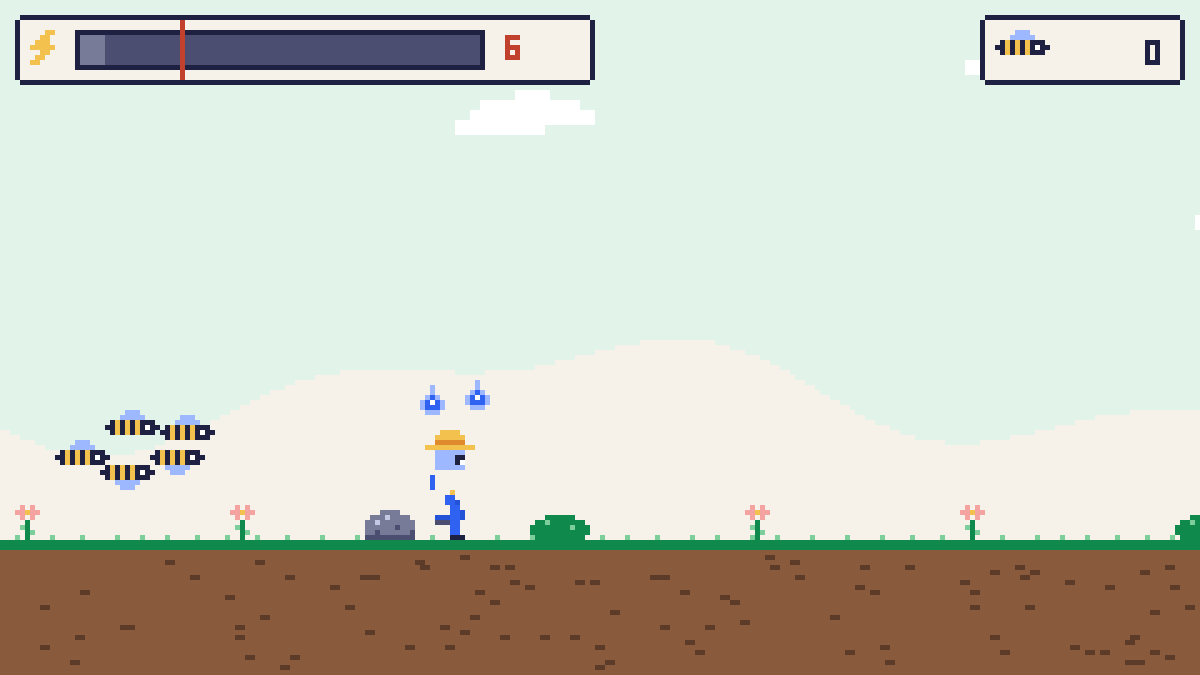
The demo is playing itself. Press a key or a button to take over.
Sprinting costs 18 a second of 100, a leap 30, and a leap needs all 30 or does not happen. After any spending the bar waits 0.7 seconds, then refills 30 a second. Run it empty and she is worn out until it is back at 25.
Try it: Sprint the whole way and watch the bar run dry: she slows to a walk and the wasps sting until the bar reaches the mark. Next time ease off before a rock and keep 30 for the leap; with 29 she cannot leap and has to climb while the wasps close in.
←→ walk X sprint, hold Space leap over a rock
What makes a game yours is a point of view: a limit you chose and keep, a theme that the rules mean and not only the pictures, and one thing your game will not do. An AI can put any theme on any game in a minute, so a theme alone says little about whose game it is. This lesson takes the stamina bar in the game above and shows the same bar asking for other rules each time it means something else.
Also in this lesson 5 things to read up on 3 questions to check yourself
The idea
A point of view has three parts, and each is a decision you can write down in a line.
- A limit you choose. Not the limit of what you can build, but one you picked and keep. In the game above, a leap costs 30 or does not happen. There is no leap on credit.
- A theme that the mechanic means. The bar is not a bar with a label on it. Its rules say something about the theme: what spends it, what gives it back, and what happens when it is empty.
- One thing your game will not do. A line that rules out something an AI would add by habit, because adding it would weaken the other two.
Our own chosen limit is in the pictures on this site: one palette of 25 colours, one cast (a beekeeper, bees, hives), everything drawn by code in whole pixels. The game above is drawn that way too.
How it works
- Play the game above and run out of breath on purpose. Hold sprint and run for the cottage. Sprinting costs 18 a second from a bar of 100, and the wasps fall behind. When the bar is empty it turns grey, she can only walk, and the wasps catch up and sting. After any spending the bar waits 0.7 seconds before it refills, 30 a second, and once it has run empty she stays worn out until it is back at 25, the mark on the bar.
- Say what the bar means here, and read every rule as a sentence about it. Here the bar is breath: a beekeeper running from a swarm. Read that way, each rule fits. You get no breath back while you are still running. Running yourself empty costs more than slowing down in time, because you are worn out until the mark. A leap needs all of its strength at once, or it does not happen.
- Give the same bar another meaning and see which rules stop fitting. Take courage. Courage is not spent by running. It would drain while a wasp comes closer and come back with something brave she does, or with her bees around her. Empty, she would not slow down but turn and run the other way. Now take daylight. Daylight drains with time alone, whatever she does, and no rest brings it back. It ends in night, and night would change the meadow rather than her legs. One bar, the same code to begin with, and three games that each need other rules.
- Write the limit and the one "will not". For the game above: a leap is all or nothing, and she has no way to fight the wasps. The second line matters more than it looks. Give her a way to swat them and the bar would decide much less, because she could stand and fight instead of pacing her breath.
- Now do it for your game. For your main mechanic, write three lines on what it means: what spends it, what gives it back, what happens at empty. Then write the same three lines for a different theme. If the lines come out the same, your theme is only in the pictures so far.
The same goes for a look. A limit you chose for your pictures is a line you can check every picture against, the way every frame of the game above uses only colours of the one palette.
What goes wrong
The shortcut is a theme painted over a finished game. The AI builds a stamina bar with the rules it knows best, and then you ask it to make the game about courage. It renames the bar, gives it a new colour and an icon, and perhaps a line of text about fear. The rules stay those of breath: sprinting spends courage, and standing still brings it back. The player plays a running game with a word on it, and the word stays a word.
You notice it by renaming the bar in your head. Call it courage, daylight, hunger. If every rule fits each name equally well, the theme is not in the rules yet. Or ask your AI which rule would be different if the bar meant another theme. If its answer is that none would, the theme was painted on.
The way out is not a better name or a darker colour. It is one rule changed so that the theme and the mechanic say the same thing, then tried in play with everything else left as it was.
Tell your AI
My game's main mechanic is [the mechanic], and in my game it means [the theme]. Help me make the rules mean it. Do not change any code yet.

1. Write the rules of the mechanic as they are now, one line each, with their numbers.
2. For each rule, say in one sentence whether it fits [the theme] and why. Then say how the rule would change if the mechanic meant [another theme]. Mark every rule that fits both equally well.
3. Write point-of-view.md with three lines: my limit, [the limit]; what the mechanic means, [the theme]; and the one thing my game will not do, [the thing].
4. Propose one change to a rule that does not fit yet. Draw the mechanic as states and moves with the change in it, write one test for every move, build it, run the tests and show me their output.
5. From now on, if a request of mine breaks a line of point-of-view.md, quote that line and ask me before you do anything.
Try it
- In the game above, sprint the whole way and let the bar run dry. She slows to a walk, the bar turns grey, and the wasps sting until it is back at the mark. That is breath, felt in your hands.
- On the next run, ease off before a rock and keep 30 for the leap. With one less she cannot leap: a red cross shows, and she has to climb while the wasps close in. The limit is a rule the player can read on the bar.
- Write the three lines for your own main mechanic, then again for another theme. Wherever the two versions say the same, you have found the rule to change first if the theme is to be yours.
Read up
Where to go deeper: the pages of ours this lesson builds on, and what others have written about its point.
The bar of this lesson as a whole blueprint: its five states, the edge cases such as a bar that flickers at empty, and where stamina meters are documented in older games.
AI Pixel Art: Let Your AI Write the Picture as Text
How a sprite written as rows of letters keeps to its palette, the check that names every wrong pixel by row and column, and what an image tool gives you instead.
AI Game Art: One Style, and What Is Still Unclear
One style sheet pasted into every image request, with a Never line that blocks what the tool does by habit, and what is still unclear about the rights in AI images.
Persuasive Games: The Expressive Power of Videogames
A book on how the rules of a game, and not only its pictures and words, make a statement about how something in the world works, which its author calls procedural rhetoric.
A free pixel art tutorial that begins with the palette: why pixel art is defined by its limits, and how a set of colours you keep to helps define a style of your own.
Check yourself: three questions
Each answer is checked and explained at once. The questions are part of the quiz, so they count for your Game Coder IQ like any other.
Four people each describe their chase game in one line. Whose line shows a point of view?
Next lesson Game Feel and Juice: Feedback First, Decoration Last
How useful was this page?
Nobody has rated this page yet.