What Makes a Game Slop, and How to Check Your Own
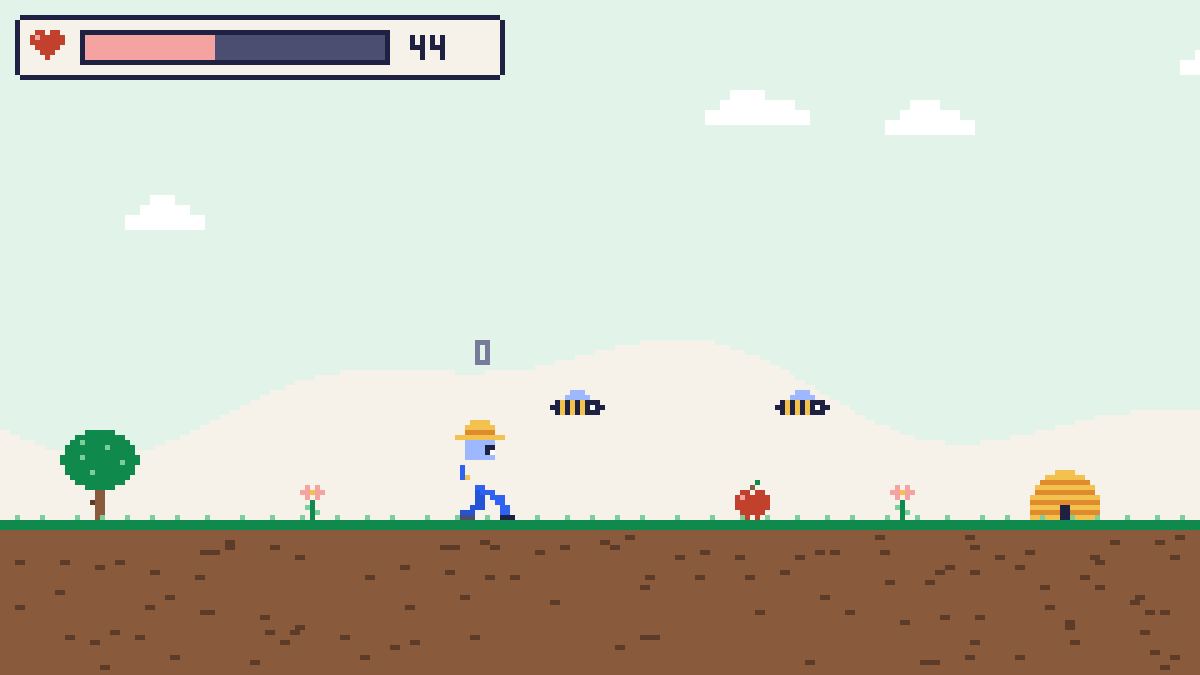
The demo is playing itself. Press a key or a button to take over.
A sting is worth 30, armor takes 2 off, so 28 go. For 0.8 seconds after a hit that landed she blinks, and whatever stings her then takes nothing.
Try it: Stand still and let two wasps in a row reach you: only the first one counts. Duck under the next. At zero, walking does nothing any more, and only getting up brings you back, with half the bar.
←→ walk ↓ duck Space get up
A slop game is one in which nobody decided anything. Its numbers are whatever came first, its theme is the most common one, its mechanics come from a list, and nobody tested whether any of it works. Whether an AI wrote the code does not decide it: an AI writes the code on this site too. What decides it is whether somebody can say, for every number and every thing in the game, who decided it and why it is so. This lesson runs that check on the game above, and then hands it to you.
Also in this lesson 5 things to read up on 3 questions to check yourself
The idea
Slop is an old word with a new sense. An article in the reading list calls it the new name for unwanted AI-generated content, and draws the line fairly: "not all AI-generated content is slop". What makes something slop there is that it was "mindlessly generated" and pushed at people who did not ask for it.
For a game, mindless has a plain meaning: a value nobody chose. A game is full of questions. The reading list has a designer who explains her job through a single door: can the player open every door, what tells them a door is locked, how big is it? Her point is that someone has to answer every one of them. In a slop game nobody did, so the defaults answered.
So slop is not a game an AI wrote. It is not a small game, a plain-looking one, or one built on a common mechanic. A health bar is about as common as a mechanic gets, and the blueprint behind the game above is not slop: each of its numbers has a reason on its page that you can read and try. A rare mechanic with numbers nobody looked at would be.
The check does not tell you whether a game is fun or will find players. It tells you whether somebody decided it. A game with a reason for every number can still be dull, but then you know which number to change and what you wanted from it.
How it works
Run the check on the game above first. It takes a few minutes, and it works the same way on yours.
- List every number you can see or feel. The full bar is 100. A sting is worth 30, of which 28 go, because armor takes 2. After a sting that lands she blinks for 0.8 seconds, and nothing else can hurt her then. When she is down and gets up, she has 50, half the bar. And an apple, once she is hurt, gives some back.
- For each one, ask who decided it and why it is so. You will get three kinds of answer, and only one of them counts.
- A reason you have tried. The blueprint's page says the blink stops one blow from landing many times, and is long enough to see what happened while short enough that danger is still felt. Stand still and let two wasps in a row reach her: one takes 28, the one right behind it flies through her and the bar does not move. Now the reason is tried, not only written.
- A reason that is not about this game. The page says of armor that small armor matters against small hits and fades against big ones. In the game above every sting is the same size. The reason is true, and it is not about this game.
- No reason. The sting's 30 and the apple belong to the demo, not to the blueprint, and the demo's code says what they are, not why. For a demo whose job is to show a health bar, that is a fair gap. In a game of yours it would be the first thing to decide.
- Try the written reasons that are left. The page says half a bar on getting up gives a second chance without wiping out the cost of going down. Let the wasps bring her down, get up, and judge with your hands whether half feels like a second chance or like a punishment. Either way, you now know something the page could only claim.
- Do the same with the things. Why wasps, why apples, why can she duck? The demo's code says the wasps fly at head height so that a standing figure is hit and a ducking one is not. That is a decision, and you can try it in a second.
What is left over, every number or thing without a tried reason, is the list of what to decide next. That list, not a feeling about the game, is what the check gives you.
What goes wrong
The shortcut is to take the AI's defaults as they came. Ask for a game with health and you get a full bar of a round number, hits that take a round share of it, a short blink, a red bar with a heart. Each value is the most common one the AI knows, and each one would pass a test. Nothing in the result is wrong. Nothing in it was chosen either, and it is the same at every layer: the theme is whatever came to mind, the mechanics are the ones that usually go with it, and nobody played long enough to see whether a hit ever changes what the player does next.
You notice it in two ways. Ask why a number is what it is, and the only answer is that it came that way. Or halve it, double it and play both: if you cannot say what changed, the number decides nothing yet.
The tempting fix is to change the numbers to unusual ones, or to swap the theme for a stranger one. That does not help. A number changed at random is as undecided as the one that came. What helps is a reason and a try: say what the number should do in play, try it, keep what does it.
Tell your AI
Help me find what nobody decided in my game. Do not change anything yet.

1. Make a table of every number and every thing in the game: sizes, speeds, damage, times, counts, prices, enemies, items, sounds and colours. For each, give the place in the code and what it does in play.
2. For each row, say who set it: "me" (quote where I said it), "you" (you picked it, also when it is a common default) or "unknown". Do not invent a reason after the fact.
3. For every number, say what a player would notice if it were half and if it were double. Mark each of those as a guess until we have tried it.
4. Show me the table and three counts: set by me, picked by you, unknown.
5. Then let me pick [three] rows and tell you the reason for each. For every one, write a test or a short play check that shows the reason holds, run it and show me the output, not your summary.
Try it
- In the game above, stand still and let two wasps in a row reach her. One takes 28 and the one behind it flies through. That is the blink's reason, tried with your own hands instead of read.
- Take a sting, then walk onto an apple and read the green number over her hat. Then look for apples on the blueprint's page: there are none, because the apple is the demo's own. You have just found a number with no reason.
- Take five numbers from your own game and write one line for each: who decided it, and why. Every line that says "the AI" or "I don't know" is the next thing to decide, and the count of those lines is your measure.
Read up
Where to go deeper: the pages of ours this lesson builds on, and what others have written about its point.
The health bar of this lesson as a blueprint: each of its numbers with the sentence that says why it is so, the edge cases, and the tests that hold the code to them.
AI Game Generator From Text: Write a Better Brief
Why a generator fills every gap with its own average idea, and a brief with six blanks, real numbers and what is not wanted, so that fewer gaps are left to fill.
Common Vibe Coding Mistakes and What Each One Costs
The habits that cost the most when you build with an AI, from no saved versions to believing it when it says done, each with what it costs and what to do instead.
Slop is the new name for unwanted AI-generated content
A short post from when the word was new in this sense: why sharing generated work that nobody reviewed is rude, and the baseline it ends on: do not publish slop.
A designer lists the questions a single door raises, from whether it opens to who fits through it, and how every other role on a large team deals with that same door.
Check yourself: three questions
Each answer is checked and explained at once. The questions are part of the quiz, so they count for your Game Coder IQ like any other.
Four games are described by how they were made. In which one did nobody decide anything?
Next lesson A Point of View in Game Design: What Makes a Game Yours
How useful was this page?
Nobody has rated this page yet.