The Smallest Whole Game: Scope a Game You Can Finish
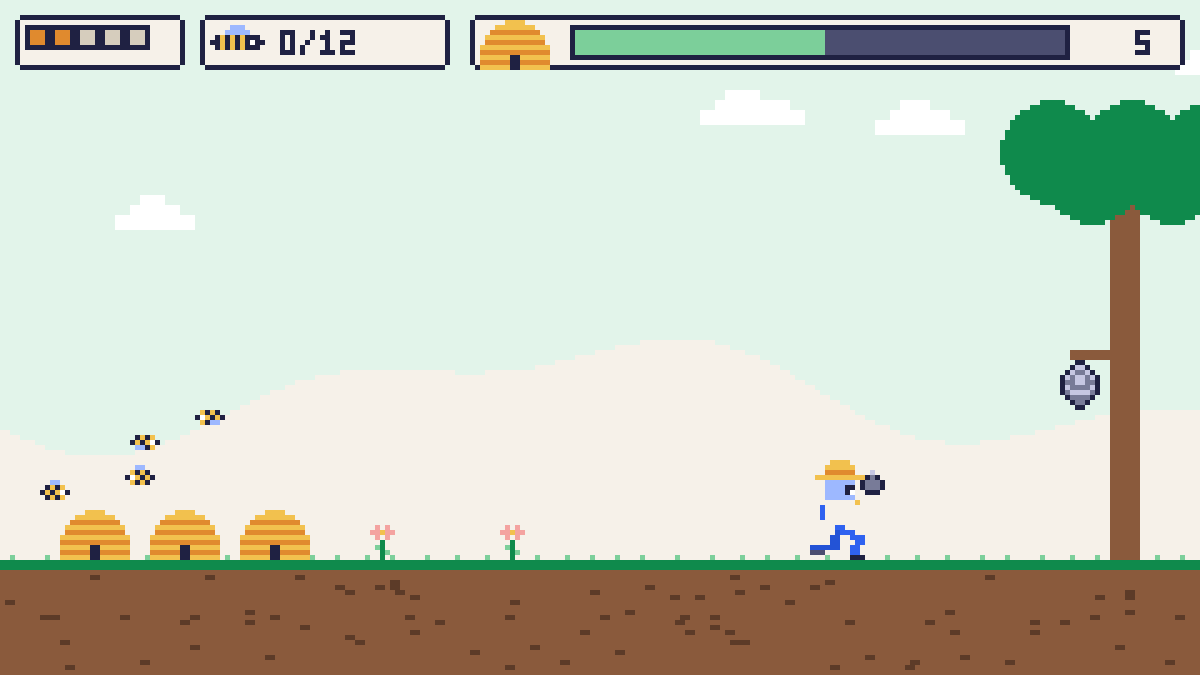
The demo is playing itself. Press a key or a button to take over.
Here the clock runs six times fast: the 8 second break takes a little over one. Five waves of 4, 6, 8, 10 and 12 wasps leave the nest 0.6 seconds apart, never more than 12 out at once. A wave not cleared after 90 seconds lets the next one start anyway, except the last.
Try it: Calm the first wasps as soon as they leave the nest: the wave goes on until all of its wasps are out, even when none is left flying. Then do nothing for a while: after the time limit the next wave comes anyway, and once 12 wasps buzz around the hives, the rest wait in the nest.
←→ walk Space puff smoke
A whole game has a start, a middle that changes and an end that the game itself notices. The smallest whole game is the smallest size at which all three are still there, together with a written list of everything else. An AI says yes to every idea you bring it, so that list is the one part only you can write. The game above is such a game: play one round to the end before you read on.
Also in this lesson 4 things to read up on 3 questions to check yourself
The idea
Whole is not the same as big, and it is not the same as polished. A game is whole when a player can start it, play through a middle in which something changes, reach an end that the game notices, and start again. Everything else, from a shop to a second enemy, is something a whole game can have, not something it needs.
The game above has exactly that and little more. The start is the break before the first wave, a bar counting down. The middle is 5 waves of wasps, each with more wasps than the one before. The end comes when the last wave is calmed: stars rise over the beekeeper, and a new round begins by itself. There is one thing to do, a puff of smoke, one kind of enemy and one meadow.
Building with an AI moves the danger. Adding a part costs you one message, so parts pile up faster than anybody can play them. What you keep small is not the work for each feature. It is the number of parts that all have to work before a round can end.
How it works
Do this with the game above first, then with yours.
- Play one round to the end. The dots at the top left are the 5 waves. The first wave has 4 wasps, and every wave after it has 2 more. The break before each wave is 8 seconds, but this game's clock runs six times as fast, so a break passes in a little over a second.
- Name the start, the middle and the end in one sentence each. For this game: a countdown starts it, waves that grow are the middle, and the last wave calmed ends it. If one of your sentences needs "and also", it is not the smallest version yet.
- Check that the end can always be reached. This is what makes a game whole rather than merely long. Stop puffing during a wave and wait. A red bar fills, and after 90 seconds of the game's clock the next break begins, although wasps are still out. The blueprint gives the reason: an enemy stuck behind a wall would otherwise hold the game up for ever. In the last wave there is no red bar. That end has to be earned.
- Write the list of what is out. For the game above, two minutes give you: no way to lose, no score, no second kind of enemy, nothing to buy between waves, no menu, no story. Wasps that reach the hives only buzz around them. Every line is something a player might expect, and the game is whole without it.
- Do the same for your game. Three sentences for the start, the middle and the end. Then the smallest version of each: for the middle, the fewest rounds that still show it changing. The blueprint's reason for its small first wave is a good test for yours: small enough that a new player can win it without knowing the game yet. Then the out list, which should come out longer than the list of what is in.
Look at the top line of that out list again. A game with no way to lose still ends, because winning can always be reached. Our seven-day plan says never to cut losing. The game above cuts it because its job is to show one rule, the waves. In a game of yours, leaving out losing is a decision to make on purpose, and it goes on one of the two lists, never on neither.
What goes wrong
Ask an AI for a shop between waves and it builds a shop. Ask for a boss and it builds a boss. Each one works when you try it alone. The AI does not ask which list a request belongs on, because there is no list, and so nothing in the project ever says no.
Each yes also reaches into the end. A shop needs something to pay with, so now there is a score, and the score needs a rule for what it counts. A boss asks the end a new question, one that the blueprint's page leaves to you: is a wave cleared when only the boss's helpers are gone? If you did not answer it, the AI did, and you find out which answer it chose on the day a round does not end.
The game that comes out of this has many parts, and each of them half works. It grows every week, and nobody has played it from the start to an end in a while. That is the sign to look for. Ask when anybody last played a whole round. If the answer is "never" or "I think it works", the game is not whole yet, however much is in it.
The way out is not to stop having ideas. It is to give each idea a place before it is built: in, or on the out list for a later game.
Tell your AI
I am making [one sentence about the game]. I want the smallest version of it that is still whole.

Before you change any code:
1. Write the start, the middle and the end of one round, one sentence each, in my words. Then write how a new round begins.
2. For each of the three, propose the smallest version that still does its job, and say what you left out.
3. Write two files: in.md with everything the smallest version needs, and out.md with everything else that exists or is planned. out.md should be the longer one. Ask me about every line you are unsure of.
4. Draw one round as states and moves, from the start to every way it can end. Check two cases on the drawing: the player does nothing, and one enemy or object can never be reached. Show me where each case leads.
5. Write one test for every way a round can end, run the tests and show me their output, not your summary.

From now on, when I ask for something new, ask me first whether it goes into in.md or out.md. If it is already in out.md, quote that line before you do anything.
Try it
- In the game above, stop puffing as soon as the first wave is out, and wait. The red bar fills, and the next break begins with all four wasps still buzzing. In the fifth wave there is no red bar: that end has to be reached by calming every wasp.
- Write the out list of the game above in two minutes, then play a round. Everything on your list is missing, and the round still has its start, its middle and its end.
- Write the start, the middle and the end of your own game in one sentence each. If the end says "and then more levels", there is no end yet: decide what the last thing is that a player does before the game notices they are done.
Read up
Where to go deeper: the pages of ours this lesson builds on, and what others have written about its point.
Finish Your Game Instead of Starting Over: 10-Day Plan
A ten-day plan from a half-built game to a published one: the three questions that tell you whether to start over, and the sorting into Must, Nice and Cut.
Vibe Coding a Game in 7 Days: A Day-by-Day Plan
A week planned day by day, with the rule that the days do not move but the cut list does, and the three things it says you never cut.
The waves of this lesson as a whole blueprint: why a wave has a time limit and the last one has none, the edge cases that keep a round from ending, and the tested code.
Two traps that keep games from being finished, restarting and polishing for ever, and the advice to keep the whole game playable from beginning to end before polishing any part.
Check yourself: three questions
Each answer is checked and explained at once. The questions are part of the quiz, so they count for your Game Coder IQ like any other.
A friend shows you four projects. Which one already has everything this lesson asks of a whole game?
Next lesson What Makes a Game Slop, and How to Check Your Own
How useful was this page?
Nobody has rated this page yet.