Tutorial Without Text: Let the First Room Teach Your Mechanic
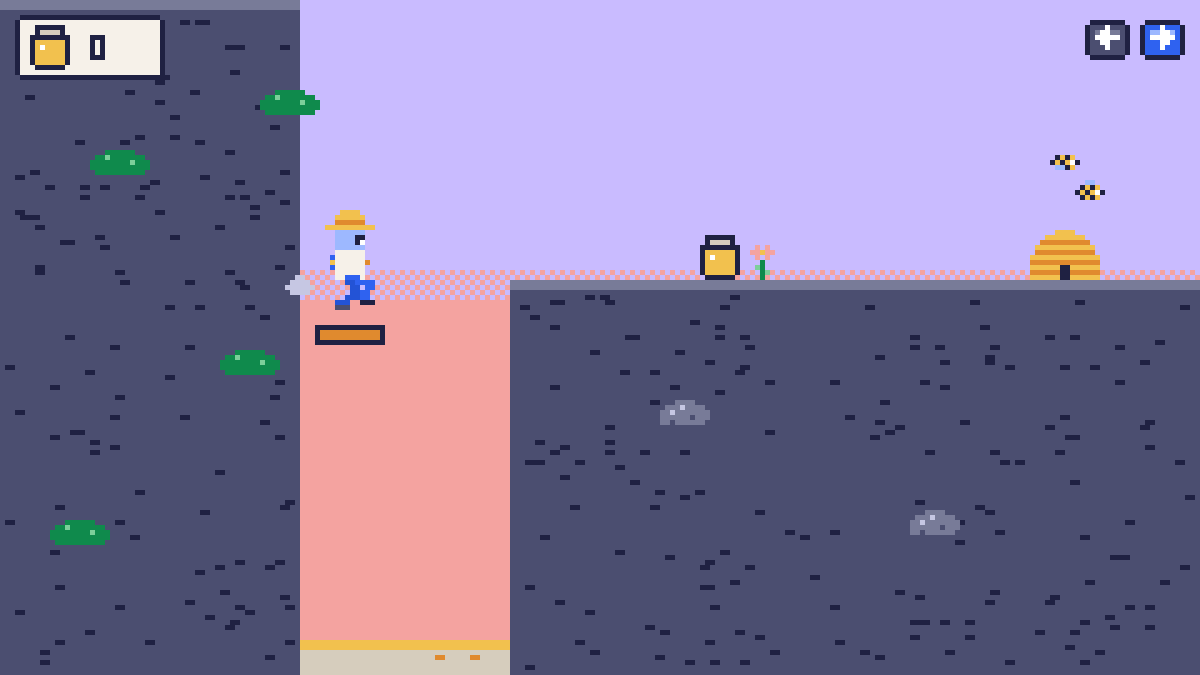
The demo is playing itself. Press a key or a button to take over.
A kick sends her up at 12 and away from the wall at 8 units a second. For 0.18 seconds, the bar under her boots, her sideways speed cannot be changed, so holding back toward the wall does not stop the kick. A press up to 0.1 seconds after leaving a wall still counts.
Try it: Jump against the tall cliff and press jump again while you touch it: you fly off the other way. Kick off and hold straight back toward the wall: you still leave it until the bar is gone. Jump on the floor right next to a wall: just a normal jump, no kick.
←→ move Space jump, kick off a wall
You can teach a mechanic without a word: build a first room that the player cannot leave without doing the thing once, and in which a mistake costs nothing. After it comes the same move with a risk, then the same move with a twist. The gorge above is such a first room for a wall jump. This lesson takes it apart, and then you write your own three rooms.
Also in this lesson 4 things to read up on 3 questions to check yourself
The idea
A text box that explains the controls tells the player what to press. It does not make them press it, and it gives them no reason to. A room can do both. Put the goal where only the mechanic reaches it, show the goal from the start, and let a failed try cost nothing. The player presses, sees what happens and tries again, and after a few tries the hands know what a text would only have said.
Then the same move comes back twice: once with a risk, so the player finds out they can do it when it matters, and once with a twist, so they find out it does more than they thought. Three rooms, one mechanic, and no sentence needed.
This is not only taste. A team at the University of Washington tried eight kinds of tutorial in three games of their own, with tens of thousands of players. The tutorials helped in the most complex game and made little difference in the two simpler ones. The authors conclude that players seem to learn more from exploring than from reading text, so early levels should let them try things and discover the mechanics. They also say plainly that their games are not like the games people buy. So take it this far: a mechanic that a room can show needs no text to explain it, and a deep, unusual one may still need some words. The paper is in the reading list.
How it works
Do this with the gorge above.
Play it once without reading the words under it. They are there because this is a page about a mechanic, not a game. Look at what the picture tells you. The honey sits on top of the lower cliff, in sight from the start. Two walls stand close together, with nothing else to push against. The floor is sand: fall, and you land and can try again, with nothing lost.
Find out what does not work. Jump in the middle of the floor: she rises and falls back, far below the top. Jump right next to a wall: the same plain jump, no kick. The room lets you try the wrong things, and each try is cheap.
Find the one thing that does. Jump against a wall, and press again while you touch it. She kicks off, up and away from the wall, and a puff marks the spot. No single kick reaches the top, so you go from wall to wall until the top of the lower cliff is within reach. Take the kick away, and nobody gets out of this gorge: that is what makes it a room that teaches.
Notice what the picture says in place of words. After each kick a short bar under her boots runs out: for 0.18 seconds her sideways speed is fixed. The two arrows in the top right corner light up for what you hold. Kick off and at once hold straight back toward the wall: the arrow lights, and she still flies away until the bar is gone. The rule is shown, not written. Every small game on this site keeps to that: no words in the picture, only numbers, bars and arrows.
Write your three rooms.
- Room one, safe: the goal in sight, your mechanic the only way to it, a mistake free. In the gorge: the honey, two walls, a sand floor.
- Room two, risk: the same move, now over something that costs. For a wall jump, say, the floor of the gorge becomes a pit that sends her back to the start of the room. Now the player finds out they can do it when it counts.
- Room three, twist: the same move, asked in a way the first two rooms did not ask it. For a wall jump, say, one wall ends below the ledge she wants, so the last kick comes just after she has risen past the wall's top. The blueprint allows for that: a press up to 0.1 seconds after leaving a wall still counts.
The gorge above is room one only. Rooms two and three are for your game.
What goes wrong
The usual message is: add a tutorial. The AI writes a text box for the first screen: "Press Space to jump. Jump against a wall and press Space again to wall jump." It closes with a button, and behind it is a level that can be walked through without a single kick. The wall jump is needed for real three rooms later, over a pit.
How it plays: the player clicks the box away, read or unread, walks through the room without kicking once, and meets the wall jump where a miss costs a life. They learn at the moment a mistake is punished, and the game punishes the learning. A text that names a button also says nothing about how the move behaves: that holding back does nothing for a moment, that a late press still counts. In the gorge above you find both out with your hands, without a word.
How you notice: switch the text off, or cover it, and give the game to somebody who has never seen it. Watch their first room. If they leave it without doing the thing, the room teaches nothing. If the spot where they do it for the first time is also a spot where a miss costs, the risk came before the safe room. And without anybody: list every way out of your first room. More than one, or one that does not need the mechanic, and the room is decoration.
Tell your AI
I want the first three rooms of my game to teach [the mechanic] without any text that explains it.

Before you build anything:
1. Describe three rooms in plain words, in this order: a safe room the player cannot leave without using [the mechanic] once, where a failed try costs nothing; a room that asks for the same move with a risk; a room that asks for it with a twist the other two did not have. For each, say what the player sees first, the only way out, and what a mistake costs.
2. Draw the three rooms as a Mermaid state diagram: each room, its way out, and where a mistake leads.

Then check it with tests that play the rooms and print what happened:
- with [the mechanic] switched off, a scripted player cannot leave the safe room;
- with it switched on, a scripted player can, and a failed try in the safe room leaves the player in that room with nothing lost;
- no text on screen in these rooms explains [the mechanic].

Show me the test output, not your summary of it. Then build only the safe room, and wait until I have watched somebody new play it.
Try it
- In the gorge above, jump on the floor right next to a wall: a plain jump, no kick. Then jump against the wall and press again while you touch it. The difference between those two is what the room teaches, and no word in the picture says it.
- Kick off a wall and at once hold back toward it. The arrow in the corner lights, the bar under her boots runs, and she still flies away: 0.18 seconds of a rule you can see.
- In your own game, list every way out of the first room. If there is more than one, or one that does not need your mechanic, close it. If a mistake there costs a life, take the cost out.
Read up
Where to go deeper: the pages of ours this lesson builds on, and what others have written about its point.
Why Players Quit Your Tutorial, and How to Fix It
When your first rooms are played: count who gets past each step and how long they stay, to find the one step that loses people, and fix that step alone.
Time to First Fun: How Long Until Your Game Is Good?
How long new players take to reach the moment your game first pays off, measured from the start, and how to cut what stands in front of it.
The wall jump of this lesson as a whole blueprint: the lock, the late press that still counts, the edge cases a first try forgets, and the tested code.
The Impact of Tutorials on Games of Varying Complexity
The study behind this lesson's claim: eight kinds of tutorial tried on many thousands of players in three games, with what helped where, and the limits its authors name.
Check yourself: three questions
Each answer is checked and explained at once. The questions are part of the quiz, so they count for your Game Coder IQ like any other.
What makes the gorge of this lesson a first room that teaches the wall jump?
Next lesson The Smallest Whole Game: Scope a Game You Can Finish
How useful was this page?
Nobody has rated this page yet.