One Mechanic, Many Levels: Level Design That Asks New Questions
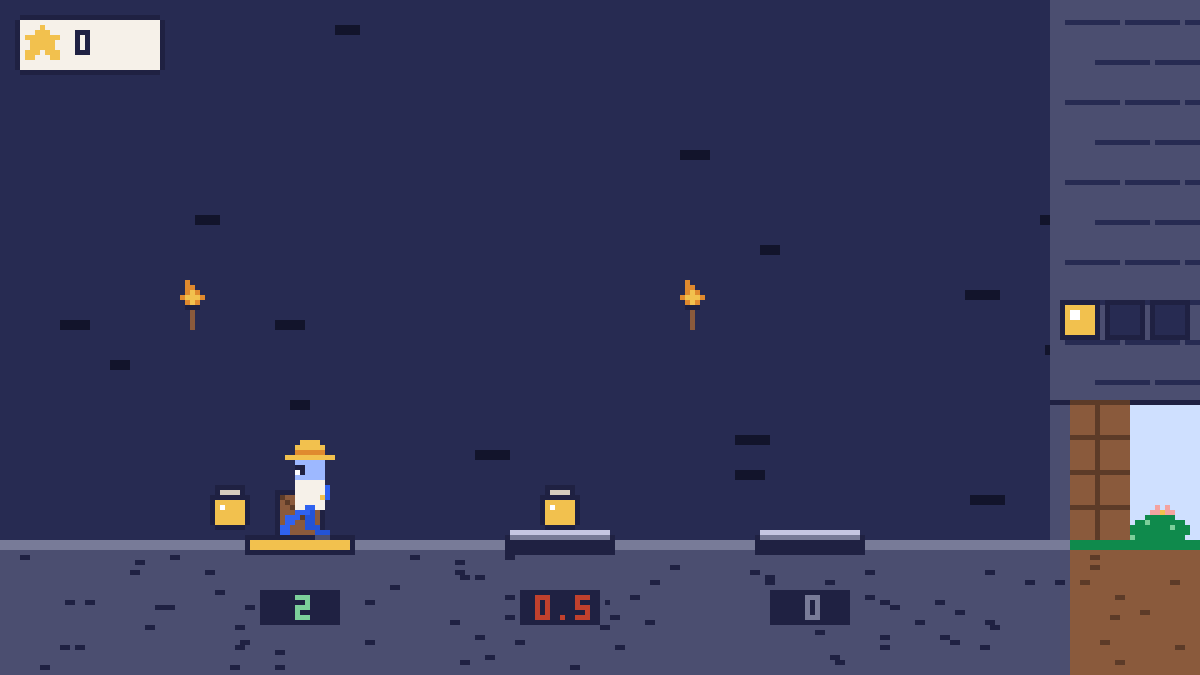
The demo is playing itself. Press a key or a button to take over.
A plate needs a weight of 1 to go down. One jar weighs 0.5 and does nothing alone; two on the same plate add up to 1. A plate comes up 0.3 seconds after the weight is gone, and the door stays open 1.5 seconds after the last plate let go, long enough to reach it.
Try it: Put one jar on a plate and walk away: the number under it stays red and the plate comes up. Bring the second jar and it stays down. With all three lamps lit, step off the last plate and run: the bar over the door runs out just after you could reach it. Hop off and on quickly and the plate does not even come up.
←→ walk Space pick up, put down
A level is a question the player answers with your mechanic. A new level does not need a new mechanic. It needs a new question, and you get one by changing one thing around the same action. This lesson reads the three plates in the cellar above as three questions, and then you write your next levels as a list with one change each.
Also in this lesson 4 things to read up on 3 questions to check yourself
The idea
Once the player has learned your mechanic, every level asks it something. A good level asks something the last one did not. A level that asks the same thing again is a repeat, however different it looks. And a level that brings in a new mechanic asks about that one, not about yours.
The new questions come from what stands around the action: what the things weigh, how many there are, where the door is, how long it waits. Change one of them and the same press means something else. Change two at once and the player cannot tell which one they are meant to figure out, and neither can you when you watch them.
The game designer Daniel Cook has a word for what happens when the questions stop: burnout. The player has learned a skill, plays with it, finds no interesting use for it, and stops using it. His essay is in the reading list. A game with one mechanic and many questions keeps its skill in use. A game that adds a mechanic for every level leaves each of them half learned.
How it works
Do this with the cellar above and a sheet of paper.
Name the action in one line. Walk with the arrows, and press the action button to pick a thing up or put it down. Carry a thing onto a plate, or stand on one yourself. The door opens only while every plate is down. That is all there is to do in this cellar.
Read each plate as a question. Write the question down while you play.
- The crate: is it heavy enough alone? Put it on a plate. The number under the plate turns green, the plate sinks, and a lamp over the door lights.
- A jar: put one on a plate and walk away. The number stays red and the plate comes up again, because a jar weighs half of what a plate needs. The question is "what adds up?", and the answer is the second jar on the same plate.
- The last plate: now there is nothing left to carry, so the last weight is you. Stand on it, and all three lamps light and the door slides up. Step off, and the question becomes "can I get out in time?". The plate comes up 0.3 seconds after you leave it, and then the bar over the door runs down for 1.5 seconds. Go at once and you are through.
One action, three questions: is it enough, what adds up, and what if the weight is you?
List what stands around the action. These are the things a level can change: what each thing weighs, how many things there are against how many plates, who or what can be the weight, and how far the door is from the last plate against how long it waits. Your levels are made of these. Nothing else is needed.
Split the cellar into levels, one change each. The cellar asks all three questions at once. A newcomer is better served by three small rooms before it:
- Room one: one plate, one crate. Is it enough?
- Room two: one plate, two jars. Changed: the crate became two half weights. Asks: what adds up?
- Room three: one plate and nothing to carry. Changed: the weight is you. Asks: can you get out in time?
- Room four: the cellar as it is, all three at once.
Check every change before you keep it. A change can also break a level or empty it. Take one jar out of the cellar, and no way through is left: three plates need a full weight each, and the crate, one jar and you cannot give it. Add a second crate instead, and the crates and the jars fill all three plates while you walk out through an open door. One change, and the question of the run is gone. Both look like small edits, and only playing them through, or a solver, tells you what they did.
What goes wrong
The usual message is: make more levels, and make them more interesting. An AI reaches for new mechanics. Level two gets a lever, level three a key, level four a moving block, level five a laser. Each of them works. Each gets a level or two, and the plates are asked their first question and then left alone.
It plays wide and thin. Every level teaches a new thing and none goes deep, so the player keeps learning controls and never gets to be clever with one. The other form of the shortcut is more of the same: six plates and six crates instead of three. That is more walking, and the plates still only ask "is it enough?", six times over.
You notice it when you write the levels as a table: the level, what changed from the level before, and the question it asks in one sentence. If the middle column says "new: lever" and "new: key", that is the shortcut. If it names two changes, split the level. If the question is the same as in the level before, play the old level's answer in the new one. If it works, the new level asks nothing new.
None of this tells you whether your levels are fun. The table only shows that each one asks something. Whether the question is a good one, people playing will tell you.
Tell your AI
My game's one mechanic is: [the action in one line]. I want more levels from it, not more mechanics.

Before you build any level:
1. List everything around the action that a level can change: what things weigh or cost, how many there are, where they stand, how long something waits, who or what can do the action. Take them from the code and name the place in the code for each.
2. Write my levels as a table: the level, the one thing that changed from the level before, and the question it asks the player in one sentence. Exactly one change per level. Mark any row with two changes or with a new mechanic.
3. For every level, check with a solver or a test that plays it: that it can be solved, with the shortest solution as a list of moves, and that the solution of the level before does not solve it. Show me the output for each level, not your summary of it.

Do not add a new mechanic, a new kind of object or a new button. If you think a level needs one, tell me why and wait.
Try it
- In the cellar above, put one jar on a plate and walk away: the number stays red and the plate comes up. Bring the second jar to the same plate, and it stays down. That is the question "what adds up?", asked without anything new.
- Light all three lamps, then step off the last plate and watch the bar over the door. Do it again and stand still after you step off: the door closes. The same plate asks something else when the weight is you.
- Write your own game's next three levels as three lines, each "changed: …, asks: …". If a line says "new: …", replace it with a change around the action you already have.
Read up
Where to go deeper: the pages of ours this lesson builds on, and what others have written about its point.
Make a Puzzle Game With AI and Keep Every Level Solvable
How your AI shows that each level can be solved, with its shortest solution from a model checker, and what that looks like when a small edit leaves a level with no way through.
Read Your Game's Difficulty Curve From Player Data
Once people play your levels: first-try wins level by level against your plan, and how to find the level that asks too much at once.
The plates of this lesson as a whole blueprint: weights that add up, a door that waits, the edge cases, and the checks that hold its timing.
An essay that maps a game as a chain of skills the player learns one after another, and names burnout: a skill learned but given no interesting use.
Check yourself: three questions
Each answer is checked and explained at once. The questions are part of the quiz, so they count for your Game Coder IQ like any other.
In the cellar of this lesson, one jar on a plate does nothing, and two jars on the same plate hold it down. Which question does that plate ask the player?
Next lesson Tutorial Without Text: Let the First Room Teach Your Mechanic
How useful was this page?
Nobody has rated this page yet.