Core Loop in Game Design: The Round a Player Repeats
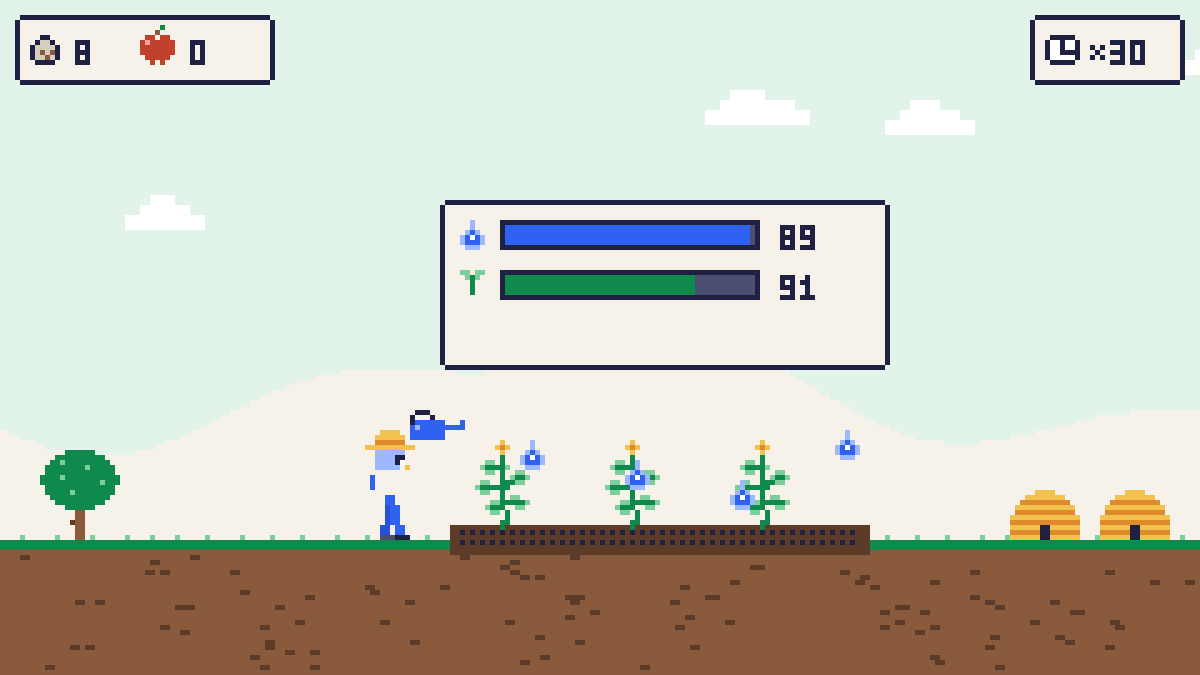
The demo is playing itself. Press a key or a button to take over.
The clock here runs 30 times fast. A crop needs 120 seconds of wet soil, one watering keeps it wet for 90, and 60 dry seconds wilt it. A ripe crop gives 3 and rots after 180. Going away for 100 seconds is worked out in one step, wet part first.
Try it: Water the bare bed and plant a moment later: the seed starts in wet soil. Pick before the fruit is red: nothing happens. Plant on a growing crop: the seed bag keeps its seed. Water once, then go home: the plants grow only for the part of your absence the soil stayed wet.
Space plant X water ↓ pick or pull out ↑ go home a while
A core loop is what the player does again and again: three or four steps in a circle, where the end of one round is the start of the next. It carries a game only if each round leaves something behind that the next round uses. This lesson walks round the farm bed above, counts what one round really changes, and then you draw your own loop and close it.
Also in this lesson 4 things to read up on 3 questions to check yourself
The idea
A loop is not a list of features. It is a circle. In the farm above it goes: sow, water, water again, pick, and the bed is bare and ready for the next seed. After three rounds you could play it with your eyes half shut, and that is not a flaw. A loop is meant to be gone round many times, and the hands should learn it.
What turns a circle into a core loop is what a round leaves behind. If a round ends with something the next round needs or can use, such as more seeds, a second bed, or a choice between a quick crop and a slow one, then round five is not round one again. If a round only moves a number that nothing in the game reads, round five is round one with a bigger number.
This matters more when an AI builds for you, because an AI asked to make a game bigger adds things: crops, places, items. The game designer Daniel Cook calls such content an arc and sets it against a loop: an arc gives its value once, a loop keeps giving while it is played. His essay is in the reading list. New things are only worth adding once the loop they go into is closed.
How it works
Do this tonight, with the farm above and a piece of paper.
Play one round and name its steps. Sow, then water, with the two buttons listed under the game. The soil turns dark while it is wet, and the plants grow. A crop needs 120 seconds of wet soil, and one watering keeps the soil wet for 90. The clock in the corner runs fast, so these are the game's seconds, not yours. So one watering is never enough: the soil turns pale, the plants stop, and a red bar starts to count. After 60 dry seconds the crop wilts. Water again before that, wait until the fruit is red, and press down to pick. The number beside the apple at the top goes up by 3, and the bed is bare.
Write the circle down, each step with what it hands on. Sowing takes a seed and gives a crop. Watering gives wet time. Watering again carries the crop through the last stretch. Picking gives fruit and a bare bed, and the bare bed is where sowing starts. Four steps, and the last one leads back to the first step. On the blueprint's own page the same circle is its diagram: bare soil, growing, ready to pick, and back to bare soil.
Play a second round and write down what changed. In the top left corner, the number beside the seed bag is one lower and the number beside the apple is 3 higher. That is all. Round two asks the same of your hands as round one, and when the bag is empty nothing more can be sown. The fruit buys nothing. The game above shows the rules of one bed and nothing else, so its circle turns but does not feed itself. It is a mechanic with a loop in it, not yet a core loop.
Close it with one arrow. Draw one arrow from what a round gives back into the next round, through something the player decides. For this farm, any one of these would do:
- Fruit buys seeds. The game no longer ends with the bag, and a crop that wilts now costs a seed you paid for.
- Enough fruit buys a second bed. Now two beds dry out at their own times, and round six asks more of you than round one.
- A fruit kept back can be sown as a slow crop that gives more. Each round now starts with a choice: quick or slow.
Pick one. With three arrows at once you will not know which one made the difference.
Ask the round-five question. What does the player have, or face, at the start of round five that they did not have at the start of round one, because of how they played? If the answer is "nothing", or "a bigger number", the loop is still open.
What goes wrong
The usual message is: make my farming game more fun, add more content. The AI does exactly that. Ten kinds of crops, a pond to fish in, a shop with things to buy, a second field behind a hill. It all works, and the first ten minutes feel rich.
Now play round five. Sow, water, pick. The harvest turns into coins, the coins go into a counter, and nothing you can buy changes the next round. The ten crops are ten colours of the same round. That is more content instead of a loop: things that are new once, hung on a circle that does not close. Once the new things have been seen, a round has nothing to give that the last one did not.
You notice it in two ways. Ask the round-five question, and the AI answers with a list of things it added, not with something that playing produced. Or look for numbers that nothing reads: coins, points, a harvest count that goes up and is never spent. Each one is a place where a round ends and the next one does not begin.
A closed loop is not yet a fun one. Whether going round feels good, only playing shows, and this lesson cannot tell you. But a loop that does not close runs dry, however much is hung on it.
Tell your AI
I want to find and close the core loop of my game: [the game in one sentence].

Before you change any code:
1. Write the loop as three or four steps the player repeats, each as "the player [does something], and that gives [what the next step needs]". The last step must lead back to the first step.
2. Draw it as a Mermaid state diagram, with one arrow from the end of a round back to its start.
3. List everything a round produces (coins, items, points, time, space) and, for each, the later step that reads it. Mark every one that nothing reads.
4. Tell me what is different at the start of round five compared with round one because of how the player played, not because of content you added. If nothing is, say so.

Then suggest one arrow that closes the loop: from something a round produces back into the next round, through a choice the player makes. Wait for my choice.

After I choose, write a test that plays several rounds with a scripted player and prints one line per round: what the player starts that round with. Run it and show me the lines. Add no new items, places or kinds of [crop, enemy, level] while we do this.
Try it
- In the farm above, water once and wait. The plants stop before they are ripe, and the red bar starts to fill. Water again before it is full: that second watering is the step that makes this circle ask something of you.
- Play two rounds and write down, after each, what the numbers beside the seed bag and the apple show. Round two changed those two numbers and nothing else. The arrow that is missing runs from the harvest back to the seed bag.
- Write your own game's loop as four lines, each "the player …, and that gives …". If the last line ends in a number that nothing reads, write the one arrow that would bring it back into the next round.
Read up
Where to go deeper: the pages of ours this lesson builds on, and what others have written about its point.
Game Design Document AI: One Page That Stays True
How to keep your loop as one line on a one-page design document beside your game, with a Mermaid diagram your AI walks through to find the holes in it.
Once real people go round your loop: how long their sessions last, where nothing happens for a while, and what they were doing when they stopped.
The farm bed of this lesson as a whole blueprint: its circle as a diagram, time away worked out fairly, the edge cases, and the tested code to build from.
A designer's essay on loops, which keep their value as the player goes round them, and arcs, which give theirs once, like a book read to its end.
Check yourself: three questions
Each answer is checked and explained at once. The questions are part of the quiz, so they count for your Game Coder IQ like any other.
In the farm of this lesson, one watering keeps the soil wet for less time than a crop needs to ripen. What does that do to a round?
Next lesson One Mechanic, Many Levels: Level Design That Asks New Questions
How useful was this page?
Nobody has rated this page yet.