Walk cycle
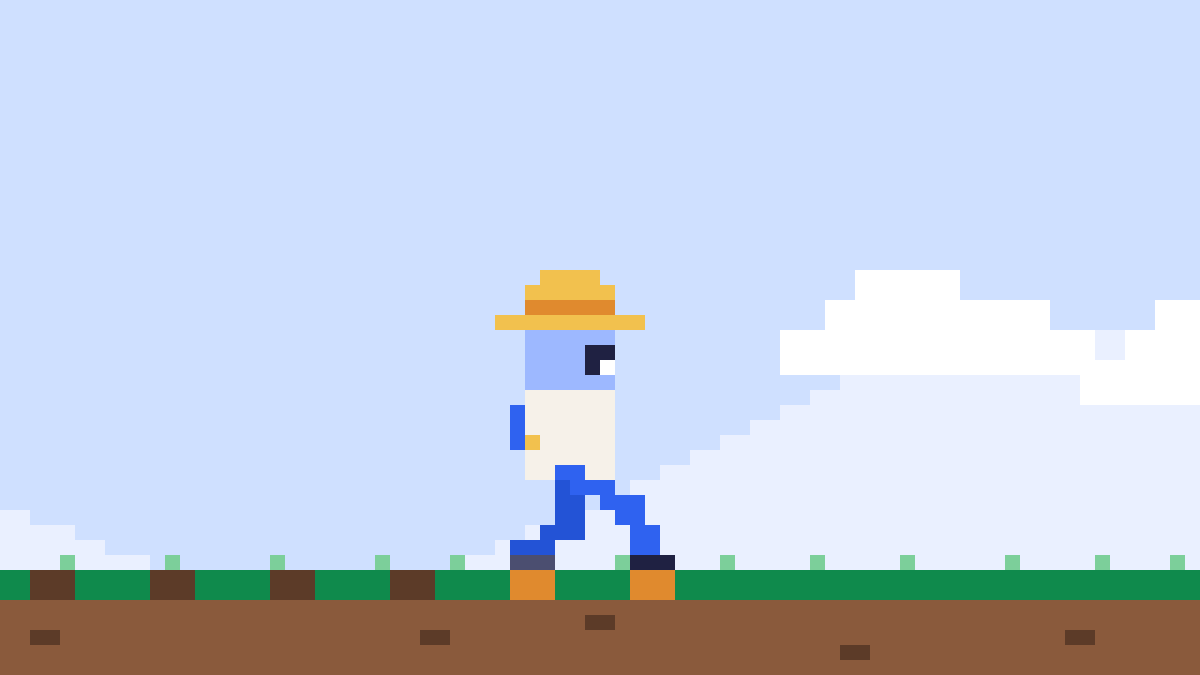
Works out where the feet, the body and the arms of a walking figure are at each moment of a step, by a rule and not from drawn frames. The cycle follows the distance the figure has moved, so a foot on the ground stays where it stands at any speed.

When you need it
For characters built from parts, such as a body with separate legs and arms, for stick figures and robots, and for making the frames of a walk without drawing them. It also checks a recorded walk and names the frame in which a foot slid. It gives you positions: how the parts are drawn is up to your game, and the arm and leg reach recipe finds the knees.
Say this to your AI
Use the walk cycle recipe from Spielerando for my character's legs and arms, driven by the distance it moves. Record 120 frames of it walking, slowing down and stopping, run the walk check on them and show me its report word for word.

The code, from https://spielerando.com/en/recipes/walk-cycle (TypeScript, tested):
```ts
/* Walk cycle: where the feet, the body and the arms of a walking figure are at each moment of a
   step, worked out by a rule instead of drawn frame by frame. The cycle is driven by how far the
   figure has moved, not by the clock, so a foot on the ground stays where it stands: at any
   speed, when the figure slows down, and when it stops in the middle of a step.

   Usage:
     // every frame, with moved = how far the figure went this frame in the direction it faces, in pixels:
     phase = advance(phase, moved);
     const pose = walkPose(phase);
     pose.left.x; pose.left.height;     // the left foot: in front of or behind the hip, and above the ground
     pose.left.onGround;                // true while it carries the figure
     pose.right;                        // the same for the right foot, half a cycle later
     pose.bob;                          // how far the body is above its resting height right now
     pose.armSwing;                     // how far the left arm is swung forward, in radians; the right arm is the opposite

     // draw the hip at (figure.x, groundY - hipHeight - pose.bob), each foot at
     // (figure.x + foot.x * facing, groundY - foot.height), and a leg between them.
     // The arm and leg reach recipe gives you the knee.

     // to check that nothing slides, record what your game really did and ask:
     const report = checkWalk(samples);  // samples: [{ x: figure.x, phase }, ...], one a frame
     report.text;                        // "No foot slides." or the frame and how far

   The phase runs from 0 to 1 and starts again: one full cycle is one step with each foot. At 0
   the left foot has just come down in front. `stride` is how far the figure travels in that
   cycle. A foot on the ground moves backward under the hip exactly as fast as the figure moves
   forward, which is why it stays put.

   `groundShare` is the part of the cycle each foot spends on the ground. Above one half there
   are moments with both feet down, which reads as walking. Below one half there are moments
   with both feet in the air, which reads as running. `supportAt` tells you which it is.

   SPDX-License-Identifier: MIT
   Copyright (c) 2026 Spielerando, https://spielerando.com */

export const DEFAULTS = {
  /** How far the figure travels in one full cycle, a step with each foot, in pixels. */
  stride: 16,
  /** The part of the cycle each foot is on the ground: above 0.5 is a walk, below it a run. */
  groundShare: 0.6,
  /** How high a foot lifts while it swings forward, in pixels. */
  stepHeight: 3,
  /** How far the body rises above and sinks below its resting height, in pixels. */
  bob: 1,
  /** How far the arms swing forward and back, in radians. */
  armSwing: 0.5,
  /** How far a foot on the ground may move between two frames before checkWalk reports it, in pixels. */
  slideTolerance: 0.01,
};

export type WalkSettings = Partial<typeof DEFAULTS>;

export interface Foot {
  /** In front of the hip (positive) or behind it (negative), in pixels. */
  x: number;
  /** Above the ground, in pixels: 0 while it stands. */
  height: number;
  onGround: boolean;
}

export interface WalkPose {
  left: Foot;
  right: Foot;
  /** How far the body is above (positive) or below its resting height. */
  bob: number;
  /** How far the left arm is swung forward, in radians. The right arm is the opposite. */
  armSwing: number;
}

export type Support = "left" | "right" | "both" | "none";

/** A phase brought back into 0 to 1; a phase that is already there is not changed by a hair. */
function wrap(phase: number): number {
  const p = phase % 1;
  const q = p < 0 ? p + 1 : p;
  return q >= 1 ? 0 : q;
}

function settingsOf(settings: WalkSettings) {
  const s = { ...DEFAULTS, ...settings };
  if (!(s.stride > 0)) throw new Error(`The stride has to be more than 0 pixels, not ${s.stride}.`);
  if (!(s.groundShare > 0 && s.groundShare < 1)) throw new Error(`The ground share has to be between 0 and 1, not ${s.groundShare}: a foot is on the ground for part of the cycle, not all or none of it.`);
  return s;
}

/** The phase after the figure moved this far. Moving backward runs the cycle backward. */
export function advance(phase: number, moved: number, settings: WalkSettings = {}): number {
  return wrap(phase + moved / settingsOf(settings).stride);
}

/** One foot at a phase. The right foot is the left foot half a cycle later. */
export function footAt(phase: number, side: "left" | "right", settings: WalkSettings = {}): Foot {
  const { stride, groundShare, stepHeight } = settingsOf(settings);
  const p = wrap(phase + (side === "right" ? 0.5 : 0));
  const reach = (groundShare * stride) / 2;
  if (p < groundShare) {
    // on the ground: from in front of the hip to behind it, as far as the figure moves forward
    return { x: reach - p * stride, height: 0, onGround: true };
  }
  // in the air: forward again, slow at both ends so that it lifts off and lands softly
  const t = (p - groundShare) / (1 - groundShare);
  const eased = t * t * (3 - 2 * t);
  return { x: -reach + eased * 2 * reach, height: stepHeight * Math.sin(Math.PI * t), onGround: false };
}

/** Which feet carry the figure at a phase. */
export function supportAt(phase: number, settings: WalkSettings = {}): Support {
  const left = footAt(phase, "left", settings).onGround;
  const right = footAt(phase, "right", settings).onGround;
  return left && right ? "both" : left ? "left" : right ? "right" : "none";
}

/** The whole figure at a phase. */
export function walkPose(phase: number, settings: WalkSettings = {}): WalkPose {
  const { groundShare, bob, armSwing } = settingsOf(settings);
  const p = wrap(phase);
  return {
    left: footAt(p, "left", settings),
    right: footAt(p, "right", settings),
    // highest when a foot is straight under the hip, in the middle of its time on the ground; twice a cycle
    bob: bob * Math.cos(4 * Math.PI * (p - groundShare / 2)),
    // an arm swings with the leg of the other side: the left arm is back when the left foot comes down in front
    armSwing: -armSwing * Math.cos(2 * Math.PI * p),
  };
}

/** The phases of evenly spaced frames, for a sprite sheet of the cycle: `frames` pictures that loop. */
export function framePhases(frames: number): number[] {
  if (!Number.isInteger(frames) || frames < 2) throw new Error(`A cycle needs a whole number of frames, at least 2, not ${frames}.`);
  return Array.from({ length: frames }, (_, i) => i / frames);
}

export interface WalkSample {
  /** Where the figure is, in pixels along the ground. */
  x: number;
  /** The phase the figure was drawn with. */
  phase: number;
  /** -1 when the figure faces and walks to the left. Left out, it faces right. */
  facing?: number;
}

export interface WalkReport {
  ok: boolean;
  /** The farthest a foot moved over the ground from one frame to the next while it stood on it, in pixels. */
  worstSlide: number;
  /** Each time a foot slid more than the tolerance: the frame it slid in, counting from 1, which foot and how far. */
  slides: { frame: number; foot: "left" | "right"; distance: number }[];
  text: string;
}

/** Checks a recorded walk: a foot that stands on the ground in two frames in a row must be in the same place in both. */
export function checkWalk(samples: WalkSample[], settings: WalkSettings = {}): WalkReport {
  const { slideTolerance, groundShare, stride } = settingsOf(settings);
  const slides: WalkReport["slides"] = [];
  let worstSlide = 0;
  for (let i = 1; i < samples.length; i++) {
    const facing = samples[i].facing ?? 1;
    // how far the cycle ran between the two frames. The phases alone cannot tell three quarters forward
    // from one quarter backward, so take the reading nearest to what the distance moved says
    const expected = ((samples[i].x - samples[i - 1].x) * facing) / stride;
    const forward = wrap(samples[i].phase - samples[i - 1].phase);
    const ran = forward + Math.round(expected - forward);
    for (const foot of ["left", "right"] as const) {
      const before = wrap(samples[i - 1].phase + (foot === "right" ? 0.5 : 0));
      // the foot stood in the first frame; if it left the ground on the way, it stands in a new place by right
      if (before >= groundShare || before + ran < 0 || before + ran >= groundShare) continue;
      const place = (sample: WalkSample) => sample.x + footAt(sample.phase, foot, settings).x * (sample.facing ?? 1);
      const distance = Math.abs(place(samples[i]) - place(samples[i - 1]));
      worstSlide = Math.max(worstSlide, distance);
      if (distance > slideTolerance) slides.push({ frame: i + 1, foot, distance: Math.round(distance * 100) / 100 });
    }
  }
  const worst = [...slides].sort((a, b) => b.distance - a.distance)[0];
  const frames = new Set(slides.map((slide) => slide.frame)).size;
  const text =
    slides.length === 0
      ? `Checked ${samples.length} frames. No foot slides.`
      : `Checked ${samples.length} frames. A foot on the ground moves in ${frames} of them. The worst is frame ${worst.frame}: the ${worst.foot} foot stands on the ground and moves ${worst.distance} pixels. The cycle is not in step with how far the figure moves: advance the phase by the distance moved, not by the time passed.`;
  return { ok: slides.length === 0, worstSlide, slides, text };
}
```
Use the walk cycle recipe from Spielerando for my character's legs and arms, driven by the distance it moves. Record 120 frames of it walking, slowing down and stopping, run the walk check on them and show me its report word for word.Settings
- stride (16): How far the figure travels in one full cycle, a step with each foot, in pixels.
- groundShare (0.6): The part of the cycle each foot is on the ground. Above one half it is a walk, below it a run.
- stepHeight (3): How high a foot lifts while it swings forward, in pixels.
- bob (1): How far the body rises above and sinks below its resting height, in pixels.
- armSwing (0.5): How far the arms swing forward and back, in radians.
- slideTolerance (0.01): How far a foot on the ground may move between two frames before the walk check reports it, in pixels.
The code
Tested TypeScript with no outside parts. Copy it into your game, or hand it to your AI together with the text above.
/* Walk cycle: where the feet, the body and the arms of a walking figure are at each moment of a
   step, worked out by a rule instead of drawn frame by frame. The cycle is driven by how far the
   figure has moved, not by the clock, so a foot on the ground stays where it stands: at any
   speed, when the figure slows down, and when it stops in the middle of a step.

   Usage:
     // every frame, with moved = how far the figure went this frame in the direction it faces, in pixels:
     phase = advance(phase, moved);
     const pose = walkPose(phase);
     pose.left.x; pose.left.height;     // the left foot: in front of or behind the hip, and above the ground
     pose.left.onGround;                // true while it carries the figure
     pose.right;                        // the same for the right foot, half a cycle later
     pose.bob;                          // how far the body is above its resting height right now
     pose.armSwing;                     // how far the left arm is swung forward, in radians; the right arm is the opposite

     // draw the hip at (figure.x, groundY - hipHeight - pose.bob), each foot at
     // (figure.x + foot.x * facing, groundY - foot.height), and a leg between them.
     // The arm and leg reach recipe gives you the knee.

     // to check that nothing slides, record what your game really did and ask:
     const report = checkWalk(samples);  // samples: [{ x: figure.x, phase }, ...], one a frame
     report.text;                        // "No foot slides." or the frame and how far

   The phase runs from 0 to 1 and starts again: one full cycle is one step with each foot. At 0
   the left foot has just come down in front. `stride` is how far the figure travels in that
   cycle. A foot on the ground moves backward under the hip exactly as fast as the figure moves
   forward, which is why it stays put.

   `groundShare` is the part of the cycle each foot spends on the ground. Above one half there
   are moments with both feet down, which reads as walking. Below one half there are moments
   with both feet in the air, which reads as running. `supportAt` tells you which it is.

   SPDX-License-Identifier: MIT
   Copyright (c) 2026 Spielerando, https://spielerando.com */

export const DEFAULTS = {
  /** How far the figure travels in one full cycle, a step with each foot, in pixels. */
  stride: 16,
  /** The part of the cycle each foot is on the ground: above 0.5 is a walk, below it a run. */
  groundShare: 0.6,
  /** How high a foot lifts while it swings forward, in pixels. */
  stepHeight: 3,
  /** How far the body rises above and sinks below its resting height, in pixels. */
  bob: 1,
  /** How far the arms swing forward and back, in radians. */
  armSwing: 0.5,
  /** How far a foot on the ground may move between two frames before checkWalk reports it, in pixels. */
  slideTolerance: 0.01,
};

export type WalkSettings = Partial<typeof DEFAULTS>;

export interface Foot {
  /** In front of the hip (positive) or behind it (negative), in pixels. */
  x: number;
  /** Above the ground, in pixels: 0 while it stands. */
  height: number;
  onGround: boolean;
}

export interface WalkPose {
  left: Foot;
  right: Foot;
  /** How far the body is above (positive) or below its resting height. */
  bob: number;
  /** How far the left arm is swung forward, in radians. The right arm is the opposite. */
  armSwing: number;
}

export type Support = "left" | "right" | "both" | "none";

/** A phase brought back into 0 to 1; a phase that is already there is not changed by a hair. */
function wrap(phase: number): number {
  const p = phase % 1;
  const q = p < 0 ? p + 1 : p;
  return q >= 1 ? 0 : q;
}

function settingsOf(settings: WalkSettings) {
  const s = { ...DEFAULTS, ...settings };
  if (!(s.stride > 0)) throw new Error(`The stride has to be more than 0 pixels, not ${s.stride}.`);
  if (!(s.groundShare > 0 && s.groundShare < 1)) throw new Error(`The ground share has to be between 0 and 1, not ${s.groundShare}: a foot is on the ground for part of the cycle, not all or none of it.`);
  return s;
}

/** The phase after the figure moved this far. Moving backward runs the cycle backward. */
export function advance(phase: number, moved: number, settings: WalkSettings = {}): number {
  return wrap(phase + moved / settingsOf(settings).stride);
}

/** One foot at a phase. The right foot is the left foot half a cycle later. */
export function footAt(phase: number, side: "left" | "right", settings: WalkSettings = {}): Foot {
  const { stride, groundShare, stepHeight } = settingsOf(settings);
  const p = wrap(phase + (side === "right" ? 0.5 : 0));
  const reach = (groundShare * stride) / 2;
  if (p < groundShare) {
    // on the ground: from in front of the hip to behind it, as far as the figure moves forward
    return { x: reach - p * stride, height: 0, onGround: true };
  }
  // in the air: forward again, slow at both ends so that it lifts off and lands softly
  const t = (p - groundShare) / (1 - groundShare);
  const eased = t * t * (3 - 2 * t);
  return { x: -reach + eased * 2 * reach, height: stepHeight * Math.sin(Math.PI * t), onGround: false };
}

/** Which feet carry the figure at a phase. */
export function supportAt(phase: number, settings: WalkSettings = {}): Support {
  const left = footAt(phase, "left", settings).onGround;
  const right = footAt(phase, "right", settings).onGround;
  return left && right ? "both" : left ? "left" : right ? "right" : "none";
}

/** The whole figure at a phase. */
export function walkPose(phase: number, settings: WalkSettings = {}): WalkPose {
  const { groundShare, bob, armSwing } = settingsOf(settings);
  const p = wrap(phase);
  return {
    left: footAt(p, "left", settings),
    right: footAt(p, "right", settings),
    // highest when a foot is straight under the hip, in the middle of its time on the ground; twice a cycle
    bob: bob * Math.cos(4 * Math.PI * (p - groundShare / 2)),
    // an arm swings with the leg of the other side: the left arm is back when the left foot comes down in front
    armSwing: -armSwing * Math.cos(2 * Math.PI * p),
  };
}

/** The phases of evenly spaced frames, for a sprite sheet of the cycle: `frames` pictures that loop. */
export function framePhases(frames: number): number[] {
  if (!Number.isInteger(frames) || frames < 2) throw new Error(`A cycle needs a whole number of frames, at least 2, not ${frames}.`);
  return Array.from({ length: frames }, (_, i) => i / frames);
}

export interface WalkSample {
  /** Where the figure is, in pixels along the ground. */
  x: number;
  /** The phase the figure was drawn with. */
  phase: number;
  /** -1 when the figure faces and walks to the left. Left out, it faces right. */
  facing?: number;
}

export interface WalkReport {
  ok: boolean;
  /** The farthest a foot moved over the ground from one frame to the next while it stood on it, in pixels. */
  worstSlide: number;
  /** Each time a foot slid more than the tolerance: the frame it slid in, counting from 1, which foot and how far. */
  slides: { frame: number; foot: "left" | "right"; distance: number }[];
  text: string;
}

/** Checks a recorded walk: a foot that stands on the ground in two frames in a row must be in the same place in both. */
export function checkWalk(samples: WalkSample[], settings: WalkSettings = {}): WalkReport {
  const { slideTolerance, groundShare, stride } = settingsOf(settings);
  const slides: WalkReport["slides"] = [];
  let worstSlide = 0;
  for (let i = 1; i < samples.length; i++) {
    const facing = samples[i].facing ?? 1;
    // how far the cycle ran between the two frames. The phases alone cannot tell three quarters forward
    // from one quarter backward, so take the reading nearest to what the distance moved says
    const expected = ((samples[i].x - samples[i - 1].x) * facing) / stride;
    const forward = wrap(samples[i].phase - samples[i - 1].phase);
    const ran = forward + Math.round(expected - forward);
    for (const foot of ["left", "right"] as const) {
      const before = wrap(samples[i - 1].phase + (foot === "right" ? 0.5 : 0));
      // the foot stood in the first frame; if it left the ground on the way, it stands in a new place by right
      if (before >= groundShare || before + ran < 0 || before + ran >= groundShare) continue;
      const place = (sample: WalkSample) => sample.x + footAt(sample.phase, foot, settings).x * (sample.facing ?? 1);
      const distance = Math.abs(place(samples[i]) - place(samples[i - 1]));
      worstSlide = Math.max(worstSlide, distance);
      if (distance > slideTolerance) slides.push({ frame: i + 1, foot, distance: Math.round(distance * 100) / 100 });
    }
  }
  const worst = [...slides].sort((a, b) => b.distance - a.distance)[0];
  const frames = new Set(slides.map((slide) => slide.frame)).size;
  const text =
    slides.length === 0
      ? `Checked ${samples.length} frames. No foot slides.`
      : `Checked ${samples.length} frames. A foot on the ground moves in ${frames} of them. The worst is frame ${worst.frame}: the ${worst.foot} foot stands on the ground and moves ${worst.distance} pixels. The cycle is not in step with how far the figure moves: advance the phase by the distance moved, not by the time passed.`;
  return { ok: slides.length === 0, worstSlide, slides, text };
}
The tests this code passes
import assert from "node:assert/strict";
import test from "node:test";
import { DEFAULTS, type Support, type WalkSample, advance, checkWalk, footAt, framePhases, supportAt, walkPose } from "./code.ts";

const close = (actual: number, expected: number, within = 1e-9) => assert.ok(Math.abs(actual - expected) <= within, `${actual} is not ${expected}`);
function random(seed: number) {
  let s = seed >>> 0;
  return () => {
    s = (Math.imul(s, 1664525) + 1013904223) >>> 0;
    return s / 4294967296;
  };
}
const phases = Array.from({ length: 2000 }, (_, i) => i / 2000);

test("the phase follows the distance: one stride is one full cycle, and it wraps both ways", () => {
  assert.equal(DEFAULTS.stride, 16);
  close(advance(0, 4), 0.25);
  close(advance(0.9, 4), 0.15);
  close(advance(0.25, 16), 0.25);
  close(advance(0.1, -4), 0.85);
  close(advance(0, 5, { stride: 20 }), 0.25);
  assert.equal(advance(0.3, 0), 0.3);
});

test("a foot on the ground goes from in front of the hip to behind it, then swings forward in the air", () => {
  // with the defaults a foot is on the ground for 0.6 of the cycle and reaches 4.8 pixels each way
  const reach = (DEFAULTS.groundShare * DEFAULTS.stride) / 2;
  close(reach, 4.8);
  assert.deepEqual(footAt(0, "left"), { x: reach, height: 0, onGround: true });
  close(footAt(0.3, "left").x, 0);
  close(footAt(0.6 - 1e-12, "left").x, -reach, 1e-9);
  assert.equal(footAt(0.6, "left").onGround, false);
  close(footAt(0.6, "left").height, 0);
  close(footAt(0.8, "left").x, 0);
  close(footAt(0.8, "left").height, DEFAULTS.stepHeight);
  for (const p of phases) {
    const foot = footAt(p, "left");
    assert.ok(foot.height >= 0 && foot.height <= DEFAULTS.stepHeight + 1e-12, `height at ${p}`);
    assert.ok(Math.abs(foot.x) <= reach + 1e-12, `reach at ${p}`);
    assert.equal(foot.onGround, foot.height === 0 && p < 0.6, `on the ground at ${p}`);
  }
});

test("a foot never jumps: its path is one closed curve, and the right foot is the left half a cycle later", () => {
  for (const settings of [{}, { groundShare: 0.4 }, { groundShare: 0.5, stride: 30, stepHeight: 6 }]) {
    for (let i = 0; i < phases.length; i++) {
      const a = footAt(phases[i], "left", settings);
      const b = footAt(phases[(i + 1) % phases.length], "left", settings);
      assert.ok(Math.abs(a.x - b.x) < 0.05 && Math.abs(a.height - b.height) < 0.05, `from ${phases[i]}`);
      assert.deepEqual(footAt(phases[i], "right", settings), footAt(phases[i] + 0.5, "left", settings));
    }
  }
  assert.deepEqual(footAt(1.25, "left"), footAt(0.25, "left"));
  assert.deepEqual(footAt(-0.75, "left"), footAt(0.25, "left"));
});

/** A walk as a game would record it: the figure moves, and the phase follows the distance. */
function record(speeds: number[], settings = {}, facing = 1): WalkSample[] {
  let x = 100;
  let phase = 0.37;
  const samples: WalkSample[] = [{ x, phase, facing }];
  for (const speed of speeds) {
    x += speed * facing;
    phase = advance(phase, speed, settings);
    samples.push({ x, phase, facing });
  }
  return samples;
}

test("driven by distance, a foot on the ground does not move: at any speed, stopping, and backward", () => {
  const next = random(11);
  // speeds in pixels a frame: steady, slowing to a stop, standing, speeding up, backward, and at random
  const speeds = [
    ...Array.from({ length: 120 }, () => 1),
    ...Array.from({ length: 60 }, (_, i) => 1 - i / 60),
    ...Array.from({ length: 30 }, () => 0),
    ...Array.from({ length: 60 }, (_, i) => i / 20),
    ...Array.from({ length: 80 }, () => -0.7),
    ...Array.from({ length: 400 }, () => next() * 4 - 1),
  ];
  for (const settings of [{}, { groundShare: 0.4 }, { groundShare: 0.5 }, { stride: 40, groundShare: 0.7 }]) {
    for (const facing of [1, -1]) {
      const report = checkWalk(record(speeds, settings, facing), settings);
      assert.equal(report.ok, true, report.text);
      assert.ok(report.worstSlide < 1e-9, `the worst was ${report.worstSlide}`);
      assert.equal(report.text, "Checked 751 frames. No foot slides.");
    }
  }
});

test("planted: a cycle driven by the clock slides as soon as the speed does not match it", () => {
  // 60 frames a second, a cycle every half second, so the phase gains 1/30 a frame whatever the speed
  const byClock = (speed: number) => Array.from({ length: 121 }, (_, i) => ({ x: i * speed, phase: (i / 30) % 1 }));
  // 16 pixels a cycle and 30 frames a cycle: only 16/30 of a pixel a frame keeps the feet still
  const matched = checkWalk(byClock(16 / 30));
  assert.equal(matched.ok, true, matched.text);
  // at one pixel a frame the figure outruns its feet by 1 - 16/30 = 0.47 pixels every frame
  const fast = checkWalk(byClock(1));
  assert.equal(fast.ok, false);
  close(fast.worstSlide, 1 - 16 / 30, 1e-9);
  // in a walk some foot is on the ground from every frame to the next, so every one of the 120 steps slides
  assert.match(fast.text, /^Checked 121 frames\. A foot on the ground moves in 120 of them\. The worst is frame \d+: the (left|right) foot stands on the ground and moves 0\.47 pixels/);
  // standing still while the cycle keeps playing: the feet moonwalk by 0.53 pixels a frame
  const still = checkWalk(byClock(0));
  close(still.worstSlide, 16 / 30, 1e-9);
  assert.match(still.text, /moves 0\.53 pixels/);
  // walking backward while the cycle plays forward: the feet slide by the sum of both, 1.53 pixels a frame
  const moonwalk = checkWalk(byClock(-1));
  close(moonwalk.worstSlide, 1 + 16 / 30, 1e-9);
  assert.match(moonwalk.text, /moves 1\.53 pixels/);
  // a little slide can be allowed
  assert.equal(checkWalk(byClock(1), { slideTolerance: 0.5 }).ok, true);
});

test("a step taken between two frames is not called a slide", () => {
  // a fast figure: 13 pixels a frame is most of a cycle, so a foot lands in a new place each frame
  const report = checkWalk(record(Array.from({ length: 50 }, () => 13)));
  assert.equal(report.ok, true, report.text);
});

/** The moves between "which feet carry the figure" that a cycle may make. */
const MOVES: [Support, Support][] = [
  ["both", "left"], ["left", "both"], ["both", "right"], ["right", "both"],
  ["left", "none"], ["none", "right"], ["right", "none"], ["none", "left"],
  ["left", "right"], ["right", "left"],
];

test("which feet carry the figure follows the cycle: a walk has both down, a run has both in the air", () => {
  const order = (settings: object, backward = false) => {
    const seen: Support[] = [];
    const list = backward ? [...phases].reverse() : phases;
    for (const p of list) {
      const now = supportAt(p, settings);
      if (seen[seen.length - 1] !== now) seen.push(now);
    }
    return seen;
  };
  assert.deepEqual(order({}), ["both", "left", "both", "right"]);
  assert.deepEqual(order({ groundShare: 0.4 }), ["left", "none", "right", "none"]);
  assert.deepEqual(order({ groundShare: 0.5 }), ["left", "right"]);
  assert.deepEqual(order({}, true), ["right", "both", "left", "both"]);
  // every change, at every ground share and both ways round, is one of the moves listed
  for (let share = 0.05; share < 1; share += 0.05) {
    for (const backward of [false, true]) {
      const seen = order({ groundShare: share }, backward);
      seen.forEach((now, i) => {
        const before = seen[(i + seen.length - 1) % seen.length];
        assert.ok(MOVES.some(([a, b]) => a === before && b === now), `${before} to ${now} at ground share ${share}`);
      });
    }
  }
});

test("the body is highest over a standing foot, and the arms swing against the legs", () => {
  close(DEFAULTS.bob, 1);
  for (const p of phases) {
    const pose = walkPose(p);
    assert.ok(Math.abs(pose.bob) <= DEFAULTS.bob + 1e-12);
    assert.ok(Math.abs(pose.armSwing) <= DEFAULTS.armSwing + 1e-12);
    assert.deepEqual(pose.left, footAt(p, "left"));
    assert.deepEqual(pose.right, footAt(p, "right"));
    close(walkPose(p + 0.5).bob, pose.bob, 1e-9);
    close(walkPose(p + 0.5).armSwing, -pose.armSwing, 1e-9);
  }
  // the left foot is under the hip at 0.3, the right at 0.8: the body is at its highest there
  close(footAt(0.3, "left").x, 0);
  close(walkPose(0.3).bob, 1);
  close(walkPose(0.8).bob, 1);
  close(walkPose(0.05).bob, -1);
  // the left foot comes down in front at 0: the left arm is all the way back, and forward half a cycle later
  close(walkPose(0).armSwing, -DEFAULTS.armSwing);
  close(walkPose(0.5).armSwing, DEFAULTS.armSwing);
  assert.deepEqual(walkPose(1.25), walkPose(0.25));
});

test("evenly spaced frames make a loop: one more step after the last frame is the first frame again", () => {
  assert.deepEqual(framePhases(4), [0, 0.25, 0.5, 0.75]);
  for (const frames of [2, 4, 6, 8, 12]) {
    const list = framePhases(frames);
    assert.equal(list.length, frames);
    const after = walkPose(list[frames - 1] + 1 / frames);
    const first = walkPose(list[0]);
    for (const foot of ["left", "right"] as const) {
      close(after[foot].x, first[foot].x);
      close(after[foot].height, first[foot].height);
      assert.equal(after[foot].onGround, first[foot].onGround);
    }
    close(after.bob, first.bob);
    close(after.armSwing, first.armSwing);
    // and the frames are evenly spaced, so the loop plays at one pace
    for (let i = 1; i < frames; i++) close(list[i] - list[i - 1], 1 / frames);
  }
  for (const bad of [1, 0, 2.5]) assert.throws(() => framePhases(bad), /whole number of frames, at least 2/);
});

test("settings that make no walk are refused", () => {
  for (const stride of [0, -5, Number.NaN]) assert.throws(() => advance(0, 1, { stride }), /stride has to be more than 0/);
  for (const groundShare of [0, 1, 1.2, -0.1]) assert.throws(() => walkPose(0, { groundShare }), /ground share has to be between 0 and 1/);
});
Common questions
why do my character's feet slide on the ground
The walk animation plays by the clock while the character moves at its own speed, and the two do not match. Drive the animation by the distance moved instead, and a foot on the ground stays put at every speed.
how do i animate a walk without drawing frames
Let a rule place the feet: on the ground a foot moves back under the hip as fast as the body moves forward, and in the air it swings to the front. Draw the legs between hip and foot, and add a small rise and fall of the body.
how do i turn a walk into a run
Shorten the time each foot spends on the ground to less than half the cycle, and lengthen the stride. Then there are moments with both feet in the air, which is what makes it read as running.
Was this page helpful?
Next step
Code recipe
Arm and leg reach
- Or: Idle sway