Meaningful Choices in Games: Something Has to Read Them
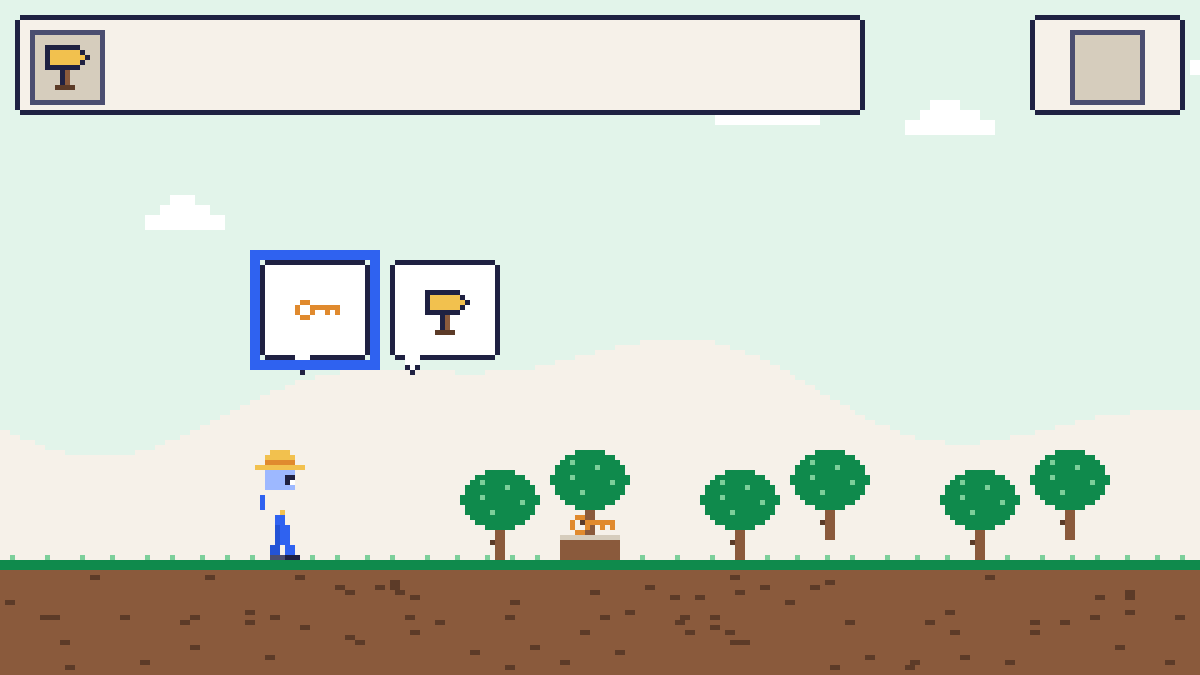
The demo is playing itself. Press a key or a button to take over.
The blueprint's own example story. Open choices come first, locked ones after them in grey, at most 4. A locked choice is refused and nothing changes. Taking the key sets a mark (top right) and the key is gone from the forest for good, unless you go back: going back puts the mark back too.
Try it: Pick the grey tower first: it shakes, and the row of places at the top stays as it was. Take the key, then press back: the key mark empties and the key lies in the forest again. Jump into the pit: no bubble is left, and only going back gets you out.
←→ choose Space take the choice X go back
In the game above, both choices in the forest lead back to the same crossroads. One of them takes the key, and from then on the grey tower is open; the other leaves it locked. That is the whole difference, and it is what makes the choice count: something later reads what it set. This lesson has you write down, for every choice in your story, what it sets and where that is read, and then hand that list to your AI together with a check.
Also in this lesson 4 things to read up on 3 questions to check yourself
The idea
A choice can do two things. It can send the player somewhere else, and it can set a fact. When the ways split and never meet again, the place itself carries the choice: whoever went left is somewhere else than whoever went right. But stories bring their ways back together, because a new story for every choice soon becomes more than anyone can write. Once the ways meet again, the only thing left of the choice is the fact it set, and that only matters if something later reads it.
An essay in the reading list, which sorts the common shapes of choice-based stories, says this plainly: stories whose branches keep coming back together almost always keep track of what was chosen, so that the earlier choices are not wiped out. A choice whose ways meet again and that sets nothing anybody reads changes the next line and nothing else.
This matters when you build with an AI, because the place that reads a choice is usually far from the choice. It is a door three scenes later, a greeting in the next chapter, an ending. An AI writes the choice in the chat where you asked for it. The place that should read it is written somewhere else, often in another chat, and nobody connects the two unless a list says they belong together.
How it works
Play the story above with the list in mind. It is small, and every part of it shows on screen.
- At the crossroads, look at the bubbles over her: a tree for the forest, a house for the town, an arrow down, and a grey tower with a lock. Pick the tower. It shakes, and nothing changes. The tower is a choice that reads something, and she does not have it yet.
- Go into the forest and pick the signpost. You are back at the crossroads, and the tower is still grey.
- Go into the forest again and take the key. You are back at the same crossroads. Now the small box at the top right shows a key, and the tower has its colour and no lock. Same place, one fact apart.
Now write the story down as a table, one row per choice: where it leads, what it sets, and what reads that. You will find that taking the key is the only choice that sets anything, and the tower is the only place that reads it. Every other choice sets nothing and counts only by where it leads.
That is fine, as long as those ways never meet again. In the town, the jar leads to the market and from there by boat to the harbour, an ending. The well leads to a well, and from there down into a pit with no way out but back. Those two places are far apart, so the choice between them is carried by the map itself. The forest is the other case: both of its choices lead to the crossroads at once, so the mark is all that tells them apart, and the tower is what reads the mark.
So the rule for your own table has two halves. For every choice whose ways meet again, at least one side must set a fact that something later reads. And every fact that something reads must be set by some choice or scene, or the tower would stay grey for everyone.
What goes wrong
The shortcut is a choice that changes the next line and nothing else. Ask an AI for "a choice that matters" and you often get two replies in different moods, a warm thank-you and a cold shrug, and then both run on into the same scene with nothing set. Or something is set, a flag named after the choice, and nothing anywhere reads it. Each reply reads well, so the choice looks finished.
In the game above, that would be a forest in which taking the key shows a key in her hand and sets no mark. The tower would stay grey whatever you picked, and the forest's two choices would be one choice with two pictures.
You notice it in two ways. Play a choice both ways up to the place where the ways meet, and compare what the game remembers there. If it is the same after both, nothing later can tell them apart. Or look at your table for empty cells: a choice that sets nothing although its ways meet again, a fact that nothing reads, a fact that is read and nothing sets.
If your story is in Twine, the checker on this site reads the file in your browser and lists every variable that is set and never read, and every one that is read and never set.
Tell your AI
Go through every choice in my story and show me what each one changes later. Do not change the story yet.

My story is in [file or folder]. If you cannot see it, ask me to paste it.

1. Make a table with one row per choice: the scene it is in, each option, where each option leads, and which facts each option sets or clears.
2. For every fact in that table, list every later scene, line, door or ending that reads it, and quote the line where it is read. If nothing reads it, write "read by nothing".
3. For every choice, follow each option forward to the earliest scene where the options' ways meet again. Write down what the game remembers there after each option. If it is the same after every option, mark the choice "changes only the next line".
4. Also list every fact that something reads and no choice or scene sets.
5. Do all this as a small check in code that reads my story files themselves. Run it and show me what it printed, word for word. Then write one test for every marked choice that plays it both ways to the meeting point and compares what the game remembers there. Run the tests and show me their output.

For each choice marked "changes only the next line" or "read by nothing", suggest one later place that could read it, and wait for me to pick. Do not add a fact or a scene without asking me.
Try it
- In the game above, go into the forest twice: once take the signpost back, once the key. Both times you stand at the same crossroads. Look at the box at the top right and at the tower: that is all that differs, and it is all a later scene can read.
- Take the key, then press back at once. You are in the forest again, the key lies on its stump, and the box at the top right is empty. Going back undid what the choice set, not only where you were, so the tower will not open on a key she never took.
- Take the biggest choice in your own story and fill its row: what each side sets, and the line that reads it. If the "read by" cell stays empty and the ways meet again, that choice changes the next line and nothing else, and you know where a later scene has to read it.
Read up
Where to go deeper: the pages of ours this lesson builds on, and what others have written about its point.
How to Make Player Choices That Really Matter
The next step after one fact: every big choice shown twice, soon and late, and a TLC model that plays a choice both ways side by side and finds the scene where both sides look the same.
Story Choice Stats: Do Your Choices Really Matter?
What players really picked, each counted once: a choice nearly everyone answers the same way is hardly a choice, and an ending nobody reached may be rare or impossible.
The story of this lesson as a blueprint: locked choices shown and refused, used-up choices that vanish, going back that restores the marks too, and the tested code.
Standard Patterns in Choice-Based Games
The common shapes of choice-based stories, each drawn as a small map, with which of them need the story to remember what was chosen and what each shape does to how a story feels.
Check yourself: three questions
Each answer is checked and explained at once. The questions are part of the quiz, so they count for your Game Coder IQ like any other.
In the game above, both choices in the forest lead straight back to the same crossroads. What makes taking the key a choice that counts?
Next lesson Map Your Dialogue Tree: Dead Ends, Lost Lines and Loops
How useful was this page?
Nobody has rated this page yet.