Timed Dialogue Choices: When Silence Becomes an Answer
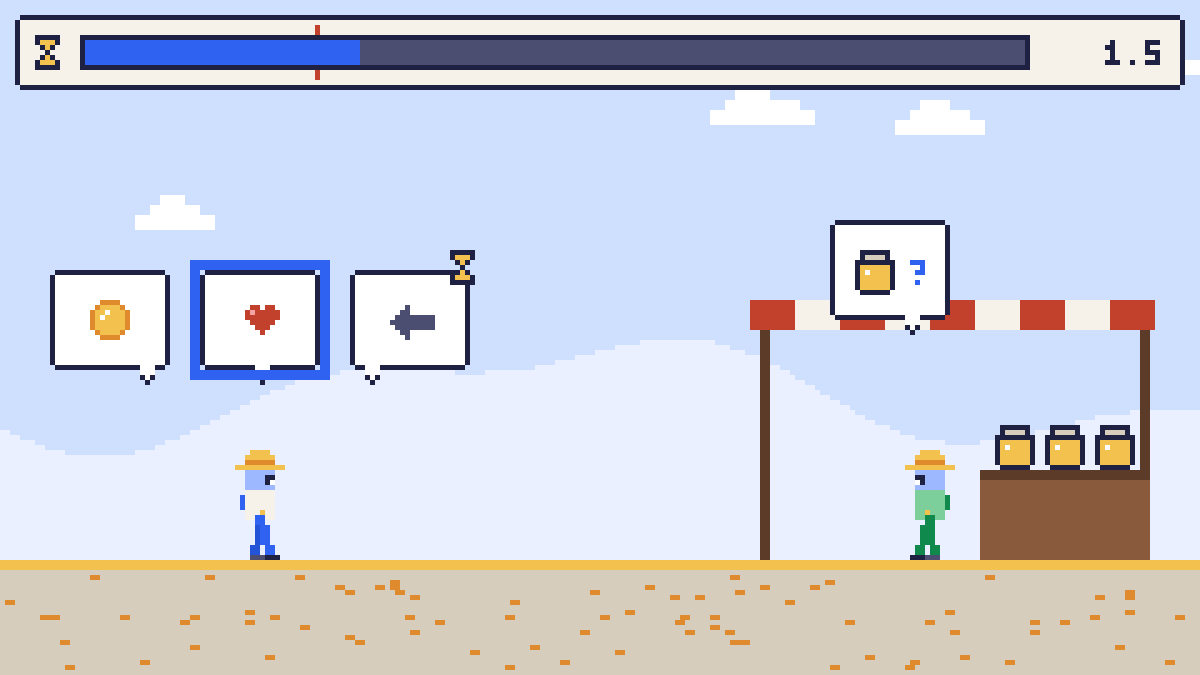
The demo is playing itself. Press a key or a button to take over.
The clock starts only when the answers are up. A question gets 4 seconds plus a quarter of a second for every picture to read: 5 seconds for the short one, 7 for the long one. The last quarter of the time is red. Run out and the hourglass answer is taken, or silence if there is none.
Try it: Watch the bar while the neighbour is still talking: it stays full. Pause in the middle of the clock and wait: the number does not move, and the answers cannot be picked. Let the long question run out: no answer is marked, so the beekeeper says nothing.
←→ choose an answer Space answer X pause the game
A clock changes what a choice is. Without one, the player answers when she is ready. With one, saying nothing becomes an answer, and the time she needs to read becomes part of the rule. The neighbour at the market stall in the game above asks two questions on a clock, and each time runs out in a different way. This lesson plays both, and then you decide which of your choices should have a clock at all.
Also in this lesson 5 things to read up on 3 questions to check yourself
The idea
A timed choice has two parts that an untimed one does not have.
- What waiting means. When the clock reaches zero, something is taken. It can be one of the answers, the one that fits a person who hesitates. Or it can be silence, which is an answer of its own, and the other character needs a reply to it.
- How long reading takes. The player has to read the line and every answer before she can choose. A long line needs more time than a short one, or the clock decides for the slow reader before she has finished.
Both are decisions about the story. Hesitating at a stall means something other than staying silent while somebody tells you that wasps are at their hive. So a clock does not belong on every choice. It belongs where hesitation means something.
How it works
- Let the short question run out. Press nothing. The neighbour asks in a picture: honey? While she speaks, the bar at the top stays full and grey. It starts to run only when the three answers appear over the beekeeper: a coin to buy, a heart for a hug, and walking away for "no, thanks". The last quarter of the bar is red. At zero, the beekeeper's bubble shows the answer marked with the hourglass, walking away. Somebody decided that a customer who says nothing walks on.
- Let the long question run out. Now she tells a story in nine pictures: wasps at her hive, the bees crying, the flowers wilting. The answers are to chase the wasps, to smoke them out, or to walk away, and none of them has an hourglass. At zero the bubble shows three dots. That is silence: the player stood there and said nothing while her neighbour told her about the wasps at her hive. In the game above the talk simply ends. In a story, that silence needs a reply.
- Count what there is to read. The short question is one picture of hers and three answers, four in all, and it gets 5 seconds. The long one is nine pictures and three answers, twelve in all, and it gets 7. Every question gets 4 seconds, plus a quarter of a second for each picture to read. The time is worked out from the reading, not picked by feel.
- Pause while the clock runs. Press pause and wait. The number does not move, and the answers cannot be picked. A clock that runs while the player cannot act takes her choice away.
- Go through your own choices. For each one, ask: does hesitating mean something here? Only where the answer is yes, write what waiting means, one of the answers or silence with its reply, and count the words to read.
What goes wrong
The shortcut starts with a reasonable wish. You ask your AI to make the conversations more tense. It puts a countdown on every choice, the same few seconds for each, started when the line begins. It looks finished, and in a quick test it works.
Then it plays badly. The choice of a name for the cat now has a clock, although nothing in the story asks for haste. A long line eats most of its own time before the answers are even on screen, so a slow reader gets a second to choose, or none. And nobody wrote what happens at zero, so the game takes the first answer on the list, or waits forever. The player who froze at the worst moment of the story is told she bought a jar of honey.
You can see it in a list. Ask your AI to list every timed choice with its time and the number of words to read. If they all have the same time, the clock was set by feel. Then ask what each one takes at zero. If the answer is "the first one" or "nothing happens", silence was never decided.
Some players cannot answer under any clock: they read slowly, use a screen reader or cannot press quickly. A setting that stretches the time and one that turns the clock off keep the story open to them, and with the clock off, nothing else in the story should change.
Tell your AI
I want some choices in my game to have a clock. Do not add any timer yet.

1. List every choice in [the scene or the file]. For each one, say in one line whether hesitating means something in the story there. Propose a clock only where it does, and say why.
2. For each choice that gets a clock, write down: the words the player has to read, the line and all answers, counted; the time it gets, a base time plus a little for each word, with a ceiling; and what is taken when the time runs out, one of the answers or silence. For silence, write the other character's reply.
3. Start the clock only when the answers are on screen. Stop it while the game is paused, and refuse a pick while it is paused. If a pick and the end of the time fall on the same frame, the pick wins.
4. Add a setting that stretches every time and one that turns the clock off. With the clock off, nothing else in the story may change.
5. Draw a timed choice as states and moves: line spoken, answers open, time running low, paused, answered, time ran out. Write one test for every move, and one test that lets every timed choice run out and prints what was taken and the reply that follows. Run the tests and show me their output.
Try it
- In the game above, pick an answer while the bar is in its red part, as late as you dare. Your pick stands, not the hourglass: a press before zero always counts before the clock.
- Pause while the bar is red, wait as long as you like, and go on. The bar goes on from exactly where it stopped. The clock measures only the time in which the player could have answered.
- Take the longest and the shortest choice you want to put on a clock in your own game. Count their words, the answers included. If you would have given them the same time, write down the time each needs, and what waiting means in each.
Read up
Where to go deeper: the pages of ours this lesson builds on, and what others have written about its point.
The clock of this lesson as a whole blueprint: a slow frame that jumps past zero, a default that is not one of the answers, the settings for players who need longer, and its tests.
How to Make Player Choices That Really Matter
When a choice really counts: later scenes show its result, and a model plays each choice both ways side by side and fails where both sides see the same thing.
The web of lines and answers a timed choice sits in, and the check for a dead end before release: every answer hidden, a line nobody can reach, or a talk that never ends.
Understanding Success Criterion 2.2.1: Timing Adjustable
The web's rule for time limits, written for people who need more time to read: let them turn a limit off, stretch it to at least ten times its length, or extend it with one simple action.
Advice from a group of studios, specialists and academics: some players find any timing hard or impossible, so avoid it where a game can do without, and make it optional where it is there for variety.
Check yourself: three questions
Each answer is checked and explained at once. The questions are part of the quiz, so they count for your Game Coder IQ like any other.
A neighbour asks the player a question on a clock. None of the answers is marked to be taken when the time runs out, and the player says nothing. What should happen?
Next lesson Ambient Barks: Telling a Game Story Without Stopping Play
How useful was this page?
Nobody has rated this page yet.