Game Mechanic Ideas: Four Places Where Mechanics Come From
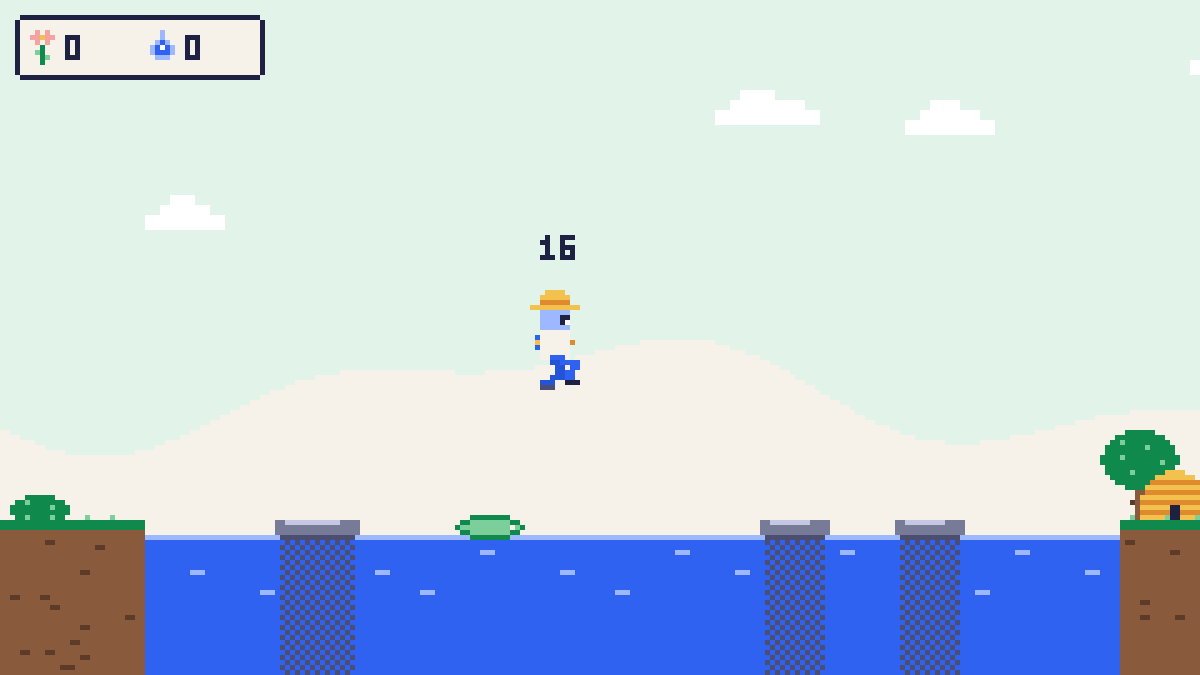
The demo is playing itself. Press a key or a button to take over.
A tap takes off at 6, a full charge after 0.6 seconds at 16, and every hold in between gets a speed on the straight line between them. Holding longer than full adds nothing. The number over her hat is the speed the blueprint's code gave this jump.
Try it: Tap to hop onto the near stone, hold a little longer for the far ones. Stand on the lily pad and keep charging: when it goes under, the charge is gone and no jump comes out of the water. Hold through a landing: nothing charges until you press again.
←→ walk, aim Space hold to charge, let go
Waiting for a mechanic to arrive does not work, and asking an AI for one does not either. You find one in four places: something people do with their hands, a limit, a known mechanic with one rule changed, and two mechanics that get in each other's way. This lesson finds all four in the charge jump above. Then you write ten ideas of your own in ten minutes, each as one sentence: the player can …, but ….
Also in this lesson 4 things to read up on 3 questions to check yourself
The idea
The previous lesson showed that a theme, a genre and a story are not mechanics. That leaves the question where a mechanic comes from, if not from a picture in your head. Here are four places to look.
- Hands. Something people do with their body or with a thing: winding up, drawing back, pouring, balancing, crouching before a leap. The player already knows how it should feel, so nobody has to explain the press.
- A limit. Take something away: one button only, no steering in the air, no walking while aiming. A limit turns an action into a choice, because now the player cannot have everything at once.
- A known mechanic with one rule changed. Start from something every player knows, such as a jump, and change exactly one rule: when it can be used, how long it lasts, what it costs, or how its size is chosen. One rule, so that you can still tell what the change did.
- Two mechanics in each other's way. Put two simple mechanics side by side that want opposite things from the player. Neither is hard alone. Together they ask for a decision every time.
Every idea from these places fits one sentence: the player can …, but …. The words before the "but" are the press, and the words after it make it a decision. "The player can jump as high as she likes, but only by standing still for longer" is an idea for a mechanic. "A jumping game on a pond" is not: there is no "but", so there is nothing to decide.
How it works
Play the game above for a minute. Hold the button briefly to hop onto the near stone, and longer for the stones further away. Then take it apart, place by place.
Hands. She crouches while you hold and springs when you let go. Holding back and letting go is a movement everybody knows from a spring or a bow, so nobody has to be told what a longer hold will do.
One rule changed. It is a jump with one rule different: its size is chosen before take-off, by how long the button is held. A quick tap takes off at 6 or just above, a hold of 0.6 seconds at 16. The number over her hat shows it after each jump. Holding longer than full adds nothing: the bar turns orange and stays there.
A limit. While she charges, she cannot walk, only turn. Once she leaves the stone, her speed to the side stays the same until she lands. So the whole jump is decided on the ground, in one hold. These two limits belong to the game above, not to the blueprint. The blueprint only says how the charge builds and what throws it away, and leaves walking while charging to you.
In each other's way. Now hop onto the lily pad. It sinks a little more the longer she stands on it, and then it goes under and takes the charge with it. The stone after it needs a long hold. The charge wants time; the pad takes it away. Do you walk to the edge first, or start charging where you landed? It is tight. Two simple things make one decision, and you make it again on every crossing.
Now the same for your own game, tonight:
- Set a timer for ten minutes.
- Write ten ideas, at least two from each of the four places, each as one sentence: the player can …, but ….
- Next to each, write which place it came from.
- In each sentence, cross out the words that name things and places. "The player can throw the lantern to light a room, but walks in the dark until she picks it up again" still says what she does and what is in her way without "lantern" and "room". If nothing is left, it was a theme. Cross it out.
- Keep the one you would most like to press. The next lesson writes its rule down.
What goes wrong
Ask an AI for game ideas and it lists genres and themes: a cozy farming game with a twist, a roguelike in a haunted library, a puzzle game about lost memories. Each one sounds like a game. Cross out the things and places, and what is left is "a game with a twist". Nothing in it says what the player presses or what stands in her way.
That is the most common answer to the question, and an AI gives the most common answer when nobody asks for something else. A twist asked for in those words can just as well be a new place or a new mood as a new rule, because nothing in the question asked for a rule.
You notice it with the test from above: cross out the things and places. A list in which every line falls apart is a list of settings. You can also notice it later, at a higher price: the AI builds the farming game, and the only thing the player does is walk to a field and press a button.
So do not ask your AI for ideas in general. Ask it to fill your four places, in your sentence form, and to cross out what is only a theme.
Tell your AI
Help me find a mechanic for my game. Do not give me genres, themes or settings.

Here is what I already have: [one sentence about your game, or "nothing yet"].
Here is a mechanic I like from somewhere else, in plain words: [for example: a jump that goes higher the longer the button is held].

Give me ten ideas, at least two from each of these four places:
1. Hands: something people do with their body or with a thing, turned into a press.
2. A limit: something the player cannot do, which forces a choice.
3. One rule changed: the mechanic I named above, with exactly one rule different. Say which rule.
4. In each other's way: two simple mechanics that want opposite things from the player.

Write each idea as one sentence: "The player can ..., but ...". Then, for each, write the press, the rule and the answer, one line each.

Before you show me the list, check it: in each sentence, cross out the words that name things and places. If what is left does not say what the player presses and what stops her, it is a theme, not a mechanic: cross it out and say so. Show me the list with the crossed-out ideas still in it, and how many are left.

Do not build anything yet. I will pick one.
Try it
- In the game above, hop onto the lily pad and reach the stone after it. Notice the moment you choose between walking to the edge and charging where you stand. Write that moment as one sentence: the player can …, but ….
- Hold on a stone until the bar turns orange, keep holding, then let go. The number over her hat still says 16. Now picture the jump without that limit, growing for as long as the button is held: a long wait would give a jump far beyond what the pond was built for. A limit is a rule you choose, too.
- Take the main mechanic of the game you want to make and change one rule at a time: when it can be used, how long it lasts, what it costs, what gives it back. Write each version as a sentence of that form. Each one is a different mechanic. Keep the one you most want to press.
Read up
Where to go deeper: the pages of ours this lesson builds on, and what others have written about its point.
Game Ideas for AI: 8 Small Games You Can Finish
Eight small game ideas we invented, what an AI builds well and badly, and three questions that pick the one idea you will finish.
The charge jump of this lesson as a whole blueprint: its states, the edge cases a first try forgets, the jumps it clashes with, and tested code.
Where Do Game Ideas Come From?
A game designer's short essay on where his ideas came from: books, films, toys and other games, and joining two things that have nothing to do with each other.
Lecture 3: Where Do Game Ideas Come From?
A recorded class in which students play a plain dice race, change one rule each, swap their versions and say how the one change altered the feel of the game.
Check yourself: three questions
Each answer is checked and explained at once. The questions are part of the quiz, so they count for your Game Coder IQ like any other.
Every idea in this lesson is written as "the player can …, but …". What does the part after the "but" add?
Next lesson How to Write a Game Mechanic Down So a Test Can Check It
How useful was this page?
Nobody has rated this page yet.