How to Playtest: Watch Somebody Play and Say Nothing
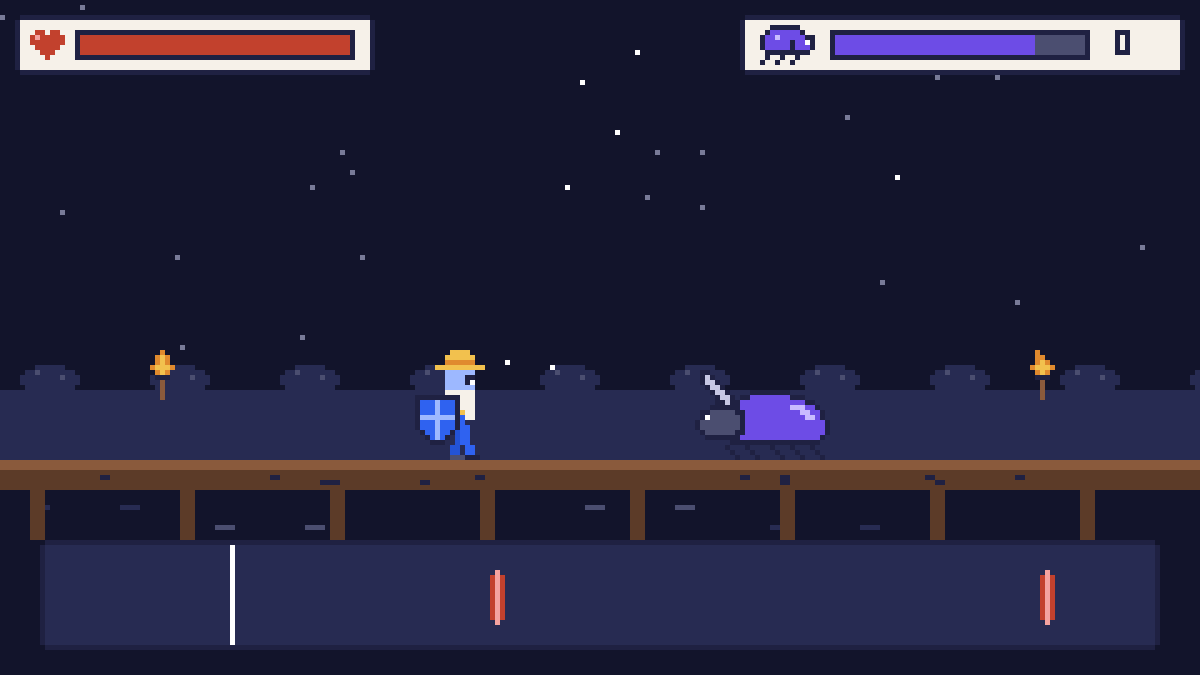
The demo is playing itself. Press a key or a button to take over.
A new press opens a window of 0.15 seconds, the yellow block in the lane: a ram inside it costs nothing and opens 0.8 seconds in which her strike counts double. A press that turns nothing aside costs half a second in which pressing again does nothing. Keeping the shield up still lets 30 percent through: 6 of a ram of 20.
Try it: Raise the shield as the ram reaches the line: 0, the beetle reels, and your strike takes 20 instead of 10. Raise it a moment early and let go: the grey pause is still running when the ram arrives, and a second press in it does nothing, so the full 20 land. Hold it up all the time: every ram costs 6.
Space shield: tap or hold X strike
You cannot playtest your own mechanic, because you already know how it works. Hand it to one person who has never seen it, say nothing about how it works, and before she starts, write down what you need to see to keep it. Then sort every stumble into the rule or the hands. What is hard must be the rule, not the hands.
Also in this lesson 5 things to read up on 3 questions to check yourself
The idea
The parry above works for you after a few tries. You know when the beetle rams, which button raises the shield, and that a press too early costs a pause. A newcomer knows none of that. Everything you know fills the gaps the game leaves, and so you cannot see the gaps.
We learned this on our own site. On 27 November 2026 the site's owner could not get across the gap in our own grappling hook demo, on desktop, in many tries. The demo had been checked with a scripted player and from screenshots, and both hid that nobody new to it could win. It was rebuilt: now the game aims at the nearest ring ahead and shows how far the rope reaches.
What is hard must be the rule, not the hands. A mechanic is allowed to be hard, and the parry is meant to be: its window is 0.15 seconds. That is the rule, a challenge you chose. What should not be hard is everything around it: knowing when the blow comes, finding the button, telling why a press did nothing. A newcomer who fails at those never gets to meet your rule.
How it works
Before she starts, write down what you need to see. Three sentences you can tick, each something that must happen for you to keep the mechanic as it is. For the parry above:
- She turns a ram aside on her own, without a word from you.
- After a press that came too early, she waits out the grey pause instead of pressing faster.
- She strikes back while the beetle reels.
Add one sentence for what would make you change it, such as: she holds the shield up all the time and never times a press. Write this before, not after. After the session, what you saw will quietly turn into what you were looking for.
Hand it over with one sentence and the keys. "It is a duel on a bridge, and these are the keys." Then say nothing about how it works: no "watch the lane", no "now". If she asks, ask back: "What do you think it does?"
Watch where she looks, and write down what she does. In the parry above there are two places to look. The beetle rears up before it rams. The lane at the bottom shows the next rams sliding towards a line, and when one reaches the line, it lands. If she presses when the beetle lunges, she is already too late: the ram landed at that same moment.
Afterwards, tick your sentences and sort every stumble. If she knew when and what to press and still missed, that is the rule: it is the challenge you chose. If she did not know when the ram comes, could not find the button, or could not tell why a press did nothing, that is the hands, and the fix is in what the game shows. The parry above already does a lot for the hands: the lane, the yellow block that is the open window, the grey bar that is the pause, and a star in the lane for every ram turned aside.
One person is enough to begin with, because you are finding out whether a newcomer can reach your mechanic at all. A round with several people is the next step.
What goes wrong
The shortcut is to test it yourself. You play the parry ten times, it works, and you move on. It works because you know it.
An AI takes the same shortcut in its own way. Asked whether the parry is playable, it plays it with a script that presses at the exact moment, and the script wins every time. Or it reads the code and says the window is a fair length. Or it looks at a screenshot and sees a yellow block and a star. All of it can be true, and none of it is a newcomer. Our grappling hook passed the script and the screenshots too.
The second shortcut comes after the session: every stumble gets the same fix, an easier rule. She kept getting hit, so the window becomes twice as long. But she was hit because she pressed when the beetle lunged, after the ram had landed. The window opens when she presses, so no length of window helps her, and now the parry is easier for everybody who did see the ram coming. Fix the hands first. Change the rule's numbers only when she knew when and what and still could not do it, and then it is tuning, the lesson before this one.
Some people who test games do talk during a session. Brian Cronin's talk in the reading list advises against staying silent and for questions such as "what are you feeling now?", and warns against steering the player and against defending your game. What you never say is how it works.
You notice the shortcuts by what is missing: nobody new has played it, there is no list written before, or the notes say "she will learn it" where they should say what she did.
Tell your AI
I am going to watch one person play [my game, or one mechanic of it] who has never seen it. I will not tell her how it works.

Before the session:
1. From the real code, write down what a new player must find out by herself to use this mechanic: each button, each thing on screen that tells her when to press, and each rule that refuses a press. Mark anything the screen does not show.
2. Help me write three sentences I can tick during the session, each something I must see to keep the mechanic as it is, such as: [she does the main move on her own, without a word from me]. Add one sentence for what would make me change it.

After the session I will paste my notes: what she did, and when.
3. Sort every stumble into the rule (she knew when and what, and still missed) or the hands (she did not know when, which button, or why nothing happened). Quote my note for each.
4. For each stumble in the hands, suggest one change to what the screen shows or to the controls that leaves the rule's numbers as they are. Do not make the rule easier unless I ask.
5. Show me my three sentences, each marked seen, not seen, or not in my notes. Do not tick anything my notes do not show.
Try it
- In the game above, play it the way a newcomer might: watch only the beetle and press when it lunges. Then play again watching the lane, and press as a ram reaches the line. What changed was knowing when, not your hands.
- Still above, raise the shield a moment early and let go. The grey bar over her hat is the pause of 0.5 seconds, and a second press in it does nothing. Ask yourself whether somebody new would read that bar as the reason.
- Before you show your own game to anybody, write your three sentences and the one that would make you change it. After the session, mark every stumble "rule" or "hands".
Read up
Where to go deeper: the pages of ours this lesson builds on, and what others have written about its point.
Playtest With Five People: What You Learn and What Not
How many people a whole round needs and why: what a handful of testers will find, what they will easily miss, and why their counts are not percentages.
Test Your Game Without Code: A 30-Minute Routine
A short routine around this step: a play script your AI writes from the game, ten minutes of trying to break it, and notes in three parts: I did, I expected, what happened.
Read Playtest Feedback With AI, Without Fooling Yourself
When the notes pile up: count people rather than comments, quote every note word for word, and check what testers said against what they really did.
The parry of this lesson as a whole blueprint: why a missed press costs a pause, why holding the button never opens a window, and the tested code.
Playtesting Process for Ultra Small Teams
The slides of a talk on one-to-one playtests for people who work alone or in a very small team: a hypothesis before every round, small rounds, and how to talk with a tester without steering or defending.
Check yourself: three questions
Each answer is checked and explained at once. The questions are part of the quiz, so they count for your Game Coder IQ like any other.
You built a parry, played it many times, and it works every time. Why does that not show that somebody new can play it?
Next lesson From Toy to Game: A Goal and Something in the Way
How useful was this page?
Nobody has rated this page yet.