The Toy Test: Prototype One Mechanic Before You Build a Game
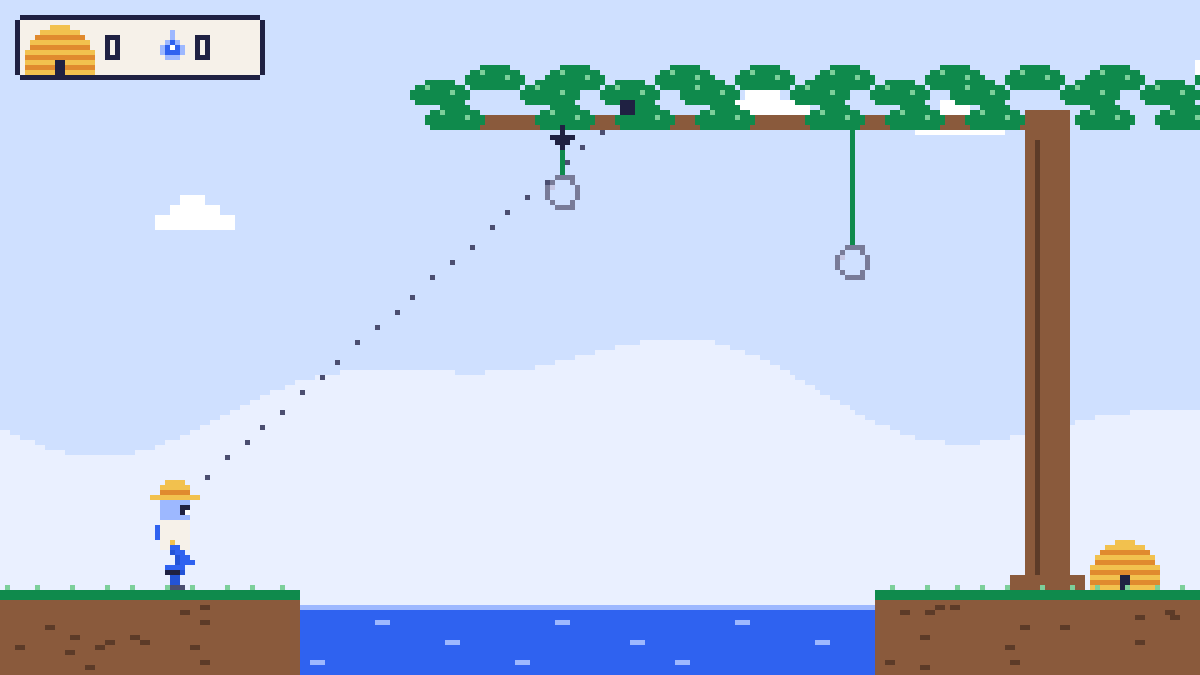
The demo is playing itself. Press a key or a button to take over.
The hook flies 40 units a second and reaches 12: the dotted line is exactly that long. Once it holds a ring it pulls her at 14, always 14 whatever her speed was, and near the ring it lets go with half of that. It has to fly back before it can be thrown again, and only a new press throws it. The game aims for you, at the ring with the arrow over it.
Try it: Throw from the start: the line ends before the ring, and the hook comes back empty. Walk right until the line reaches the ring, then press and hold: the rope pulls you up. When it lets go, press again in the air for the second ring, and you land on the far bank. Or keep the button held after it lets go: nothing is thrown until you press anew.
←→ walk, turn Space throw, hold to be pulled
The toy test is the mechanic alone, in a room of grey boxes, with no goal, no score, no menu and no art. You play it for two minutes and watch yourself: do you keep pressing? If you do, there is something to build a game on. If you do not, no level or story will change that, and this is the cheapest moment to find out.
Also in this lesson 4 things to read up on 3 questions to check yourself
The idea
By now you have a mechanic in one sentence and its rule written down. Before your AI builds anything around it, find out whether the press is worth doing for its own sake. A goal and a score can keep a player busy for a while. They give her a reason to press, not a wish to.
That is why the toy comes before the game. A team that made many small games, each in under a week, called this building the toy first: the core mechanic with no win and no lose, just something to play with, made to feel good before any game is added. Their article, in the reading list, also says it the other way round: heavy theming will not save a bad design.
The toy test cannot tell you whether your game will be fun, or whether strangers will understand it. It tells you whether the one action at its centre is worth repeating. A later lesson hands it to somebody who has never seen it.
How it works
The game above is nearly a toy already: one mechanic, two rings and a river. For two minutes, play it as one. Forget the far bank and the numbers in the corner.
Before you start, write down in one line what you would need to see to keep this mechanic, and in another what would make you drop it. Then play, and look for four signs.
- You press again without a reason. Throw from the start: the line ends before the ring, and the hook comes back empty. Do you throw again at once, or put it down?
- You try something nobody told you. Turn round and throw at nothing. Let go halfway up the rope. Throw again in the air after the rope lets go. Each of these is a question your hands ask the rule.
- A different press gives a different result you can see. Hold, and the rope pulls her up to the ring at 14 and lets her go there with half that speed. Let go early, and she flies on from where she is, with the same half, and comes down somewhere else. When to let go is a choice, and you can see what you chose.
- When it goes wrong, you can tell why, and the hard part is the rule, not your hands. The dotted line from her hand is exactly as long as the hook reaches, so a throw that comes back empty tells you why. The hook reaches 12 units, and so does the line.
The fourth sign is the one this game failed at first. Its first version asked you to aim by hand in eight directions, from one exact spot, and to throw again within a fraction of a second. The owner of this site played it and never once got across. The hook's rule was not the problem, and it was not changed. The toy around it was rebuilt: the game now aims at the nearest ring ahead, the dotted line shows the reach, she falls more gently so there is time for the second throw, and the rings hang in new places.
After two minutes, read the two lines you wrote before you played. Did you see what you needed? Believe what you saw, not what you hoped.
What goes wrong
Ask an AI for a grappling hook game and it builds a game: a title screen, a map of worlds, levels with spikes, a shop for a longer rope, a story about a lost bee. It does that gladly and fast, and every level is laid out around how far the hook reaches and how it aims. If throwing is no fun, or aiming is too hard, every one of those levels stands on it, and changing the hook means changing all of them.
It looks like progress. There are many files, and a screenshot looks like a game. But nobody has thrown the hook again and again in an empty room to see whether they wanted to.
You notice it with one question: can I play the mechanic alone, in an empty room, with nothing else? If the answer needs the menu, the first level or the story, the toy was never tested. A second sign comes later: you reach for new art or a new effect to make it feel better. Stop there, and go back to the toy.
Tell your AI
Before you build anything else, build a toy version of [the mechanic] so that I can test it by playing.

The toy is the mechanic alone in one empty room: a floor, a few grey boxes [and whatever the mechanic needs to act on, for example: rings to hook onto], nothing else. No goal, no score, no menu, no story, no art, no sound. One key puts the room back to the start at once.

Show the rule's own numbers in the room where the player needs them, for example a line as long as the reach, or a bar that fills while a button is held.

First write the mechanic as states and moves, and one test for every move. Run the tests and show me their output before I play.

Then list every file you made and what it is for. If anything is not the mechanic, the room or the tests, remove it and tell me what you removed. Do not add levels, menus or art until I tell you the toy is worth keeping.
Try it
- In the game above, play for two minutes without crossing. Make a mark on paper for every throw you made only to see what would happen. Those marks are what the toy test is about.
- Let go of the button at different points of the pull, and watch where she comes down each time. You are trying out a choice the rule gives you, and nobody had to explain it.
- Paste the text above for your own mechanic, play the toy for two minutes and write three lines: did I press again without a reason, what did I try that nobody told me, and when it went wrong, was it the rule or my hands? If the toy fails, change the toy before anything is built on it.
Read up
Where to go deeper: the pages of ours this lesson builds on, and what others have written about its point.
Is It a Game Yet? Six Questions for a Vibe-Coded Game
The step after this one: six questions that show what your toy still lacks to be a game, from a goal and something in the way to a reason for one more round.
Time to First Fun: How Long Until Your Game Is Good?
How to time, with real players, the moment your game first pays off, and how to find and cut what stands between the start and that moment.
The hook of this lesson as a whole blueprint: its states, the edge cases a first try forgets, and the tested code your AI can build its toy from.
How to Prototype a Game in Under 7 Days
A team that made many small games, each in under a week, on building the toy before the game, on why theming cannot save a weak mechanic, and on when to drop an idea.
Check yourself: three questions
Each answer is checked and explained at once. The questions are part of the quiz, so they count for your Game Coder IQ like any other.
What does a toy test leave out on purpose?
Next lesson How to Tune a Game Mechanic: One Number at a Time
How useful was this page?
Nobody has rated this page yet.