When Is a Game Done? When a Stranger Finishes It
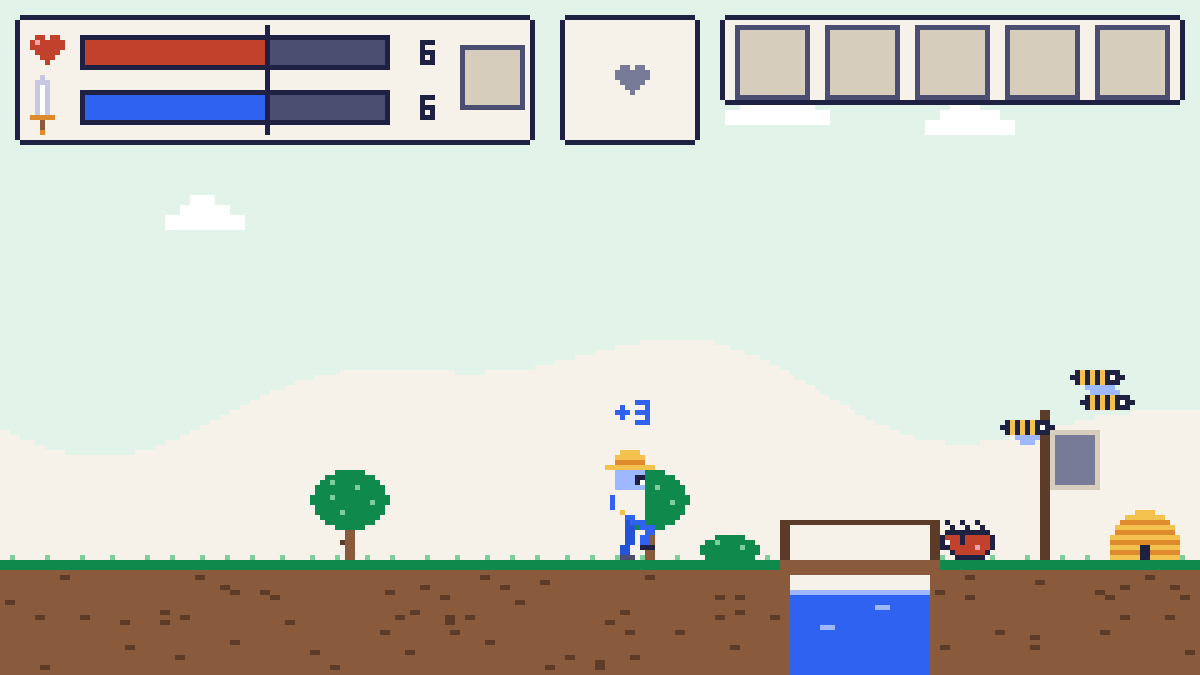
The demo is playing itself. Press a key or a button to take over.
Endings are checked from the top and the first that fits wins: the star needs the flower and both bars at 6, the heart needs kindness at 6 and at least as much as boldness, the sword boldness at 6, and staying home always fits. At the bridge the ending is fixed; only a fall can still change it.
Try it: Fill both bars to 6 without the flower: the slot shows the heart, because a tie goes to kindness. Cross the bridge, then help the beetle behind it: the bars do not move. Drive off the big nest past the bridge and see the stings end your walk with the grey heart, locked ending or not.
←→ walk Space help a beetle X drive off a nest ↓ search the bush
A game is done when somebody who has never seen it plays it from the start to an end, alone, and knows it was the end. Not when it works on your machine, and not after one more feature. This lesson tries that on the walk home above, which has 5 endings, and gives you the short list of what done needs and the longer one of what it does not.
Also in this lesson 5 things to read up on 3 questions to check yourself
The idea
This course began with one press, one rule and one answer, and tested them before anything was built on top. Every lesson since was a decision you made instead of your AI, and this last one is the decision to stop.
You cannot see from the inside whether a game is done. You know which button helps a beetle, where the flower is hidden and what the end looks like. Your AI knows it too, because it wrote it. A stranger knows none of it. So done is measured on her, not on you.
It happened on this site: a screenshot of one of our own demos looked fine, and nobody could win the game in it. A picture cannot show whether a game can be finished. Only somebody playing it to the end can.
In the game above, the beekeeper walks home across a meadow. She can help beetles that lie on their backs, drive off wasp nests and search a bush. The bridge is the point after which the ending is fixed, and at home the story ends.
How it works
Play the walk three times, once for each thing done needs from the game itself.
First, reach an end doing nothing special. Press nothing but right. You reach home, and the ending that fits comes up big in a frame: here, the one for staying home. A stranger who does nothing special still finishes, and she sees that she did. That is what an ending is for: it tells her it is over.
Second, try to get stuck. Walk back across the bridge, press every button everywhere, help the beetle behind the bridge. After the bridge your deeds no longer count, and a grey 0 says so, but nothing stops you from walking home. Drive off the big nest past the bridge, and the stings end your walk with the grey heart. Losing is an end too, and it looks like one. Every way through this walk reaches an end.
Third, notice what you did not need. The star needs the flower from the bush and both bars up to the line at 6. A stranger who never searches the bush never sees the star, and she has still finished. Done does not need her to find everything; it needs that whatever she does ends.
From those three, the short list. Done needs:
- A start without you. It opens on her device, from a link or a file, and the first screen or room shows what to press.
- An end on every way through. No spot with nothing left to do, no press that freezes the game, and losing ends too.
- An end that says it is the end, so that she does not take it for a game that stopped working.
- Her words afterwards. She can tell you how it ended.
Done does not need a second ending, more levels, a menu of settings, saving, a high score, every secret found, or the idea you had this morning. Those go on your list of what is out.
Then the stranger. Send the game to somebody who has never seen it, with one sentence: play until it ends, then tell me how it ended. Add nothing about how to play. If the game needs more words, the first screen needs them, not your message. A source from testing software in the reading list puts it plainly: in a test without you, the written instructions need to stand on their own. When she answers, ask how it ended, and where she stopped if it did not. If she can name the end, the game is done.
What goes wrong
The shortcut is to take the AI's word for it. It says the game is complete when its tests pass, or after it started the game once in its own window. It knows the controls because it wrote them, and it knows where everything is. On your machine the game works, because the files, the browser and the habits are yours. Then you ask for one more feature, it says yes, and done moves one feature further away.
For the stranger it looks different. A black screen, because a file loads from a folder only you have. A spot where she has nothing left to press and does not know it. Or an end she does not recognise. Picture the walk home without the big picture at the end: she walks up to her hive, and nothing happens. To you that is the end, because you know. To her it is a game that broke.
You notice it by asking your AI how it knows the game can be finished. If the answer is its own word, the game is not done. Ask for a walk over every state of the game, in code, and its output instead. Then ask the one question that settles it: has somebody who has never seen it finished it?
Tell your AI
I want to know whether my game is done. Done means: somebody who has never seen it plays it from the start to an end, alone, on their own device, and can tell me how it ended. Add no feature until we know.

1. Draw my game as a Mermaid state diagram, from the first screen to every ending, losing included, with every way between them.
2. Check the drawing with a walk over it, in code: every state can reach an ending, every ending can be reached from the start, and no state leaves the player with nothing to do. Run it, show me the output and list every state that fails.
3. For every ending, show me what the player sees there, with the place in the code. An ending must say that it is the end.
4. Build the version a stranger gets, start it the way they would, and tell me what you tried and what happened. If you could not do this, say so.
5. Write down what is not in this game: everything I asked for that the points above do not need.

Then give me the one sentence I send with the game. If it needs more than "play until it ends, then tell me how it ended", tell me what is missing in the game instead.
Try it
- In the walk home above, press nothing but right. You reach home, and the ending for staying home comes up big. That is a whole game for a stranger too, and it is finished.
- Cross the bridge, drive off the big nest and let the stings end your walk: the grey heart is an end as well. Then look at the row of slots at the top. Every ending you reached is kept there, also across new games.
- Send your own game to one person who has never seen it, with only "play until it ends, then tell me how it ended". If she can name the end, it is done. If she cannot, her answer is your next job, and it is not a new feature.
Read up
Where to go deeper: the pages of ours this lesson builds on, and what others have written about its point.
Finish Your Game Instead of Starting Over: 10-Day Plan
A ten-day plan from a project that keeps growing to one round a stranger can finish, with the lists of what is a must, what is nice and what is cut.
Playtest With Five People: What You Learn and What Not
How to run a test with a few people who have never seen your game while you say nothing, what their stumbles can tell you and what not, and why you count problems, not shares.
Publish a Game on itch.io: Steps for Vibe Coders
How to pack a browser game so that it runs from a link on somebody else's device, and the packing mistakes that give a black screen there and not at home.
Remote Usability Tests: Moderated and Unmoderated
From testing software: what you lose when you are not there while somebody tries your work, why the written task then has to stand on its own, and when a test without you fits.
Where software teams get the idea of a definition of done: one written description, shared by everyone, that a piece of work must meet before it counts as finished.
Check yourself: three questions
Each answer is checked and explained at once. The questions are part of the quiz, so they count for your Game Coder IQ like any other.
Which of these shows that your game is done, in the sense of this lesson?
How useful was this page?
Nobody has rated this page yet.